War in the Old Testament

Several years ago, I preached a sermon on War in the Old Testament.  To this day, I continue to have conversations about whether or not God is violent, and whether or not God condones violence.

Below is my sermon.  It’s by all means not exhaustive, but I still find it to be a good start to understanding some of the more troubling aspects of the Bible.


War in the Old Testament is one of the biggest theological questions we have, but one I we don’t put a lot of time to.  I think we just ignore it.

But some people don’t. They write books on it.  They offer courses on it.  Us?  We’re giving it a solid 20 minutes.

So because of that, I am going to be using some incredibly broad strokes today.

So if you’re thinking:  Hey!  He didn’t talk about this, or that, or he missed that.  My answer is yes.  I did.

Okay, let’s start.

War in the Old Testament.  One of the biggest problems people have with this whole Christianity thing.  We all get Jesus, “love your neighbour” thing, but what do we do with this “God who orders the destruction of entire cities” thing?

Well, the first step, is tea parties.

A typical scene in my house involves me laying on the couch, either reading or sleeping.

And then Arianna calls from across the room.

Daddy.

I don’t respond.

“Daddy.”

“Daddy!”

“Kyle!  Look at me!”

“What?”

“Tea Party.”

“What?”

“Tea Party. Come.”

“No.  I’m reading.”

“Daddy Tea Party.”  And then she’ll grab my hand and pull til I go sit on the little chair that’s the size of one of my butt cheeks.

“Daddy drink.”

And so I take this little cup, and we cheers, and we have a tea party. And then we pour some more, and then we give the teddy bear and the doll some water, and I end up loving every minute of it.

One day, I was bored of having a tea party, so I said:  “Arianna, let’s wrestle.”

She looked at me, and then I grabbed her and started jumping on her and tickling her and laughing out loud.

Two minutes later, we had stopped to gather our breath, and then she looked at me, smile.

“Tea Party?”

This is the foundation for war in the Old Testament.

I choose to work with Arianna in ways that she will understand.  I work with Arianna at her level.

We don’t watch Modern Family or Game of Thrones together.  We watch Caillou and Toopy and Binoo.

We don’t read Lord of the Rings.  We read Murmel Murmel Murmel and the Potty Book.

We don’t have chicken cordon bleu.  We have cheese and peanut butter buns and cucumbers with dip.

I don’t teach her a zone defence for Ultimate Frisbee and make her run laps.  We stack the pylons.

I choose to work with Arianna in ways that she will understand.

Eventually, she will grow up and learn.  But in the mean time, I will put up with Toopy and Binoo, because I love Arianna.

In order to understand War in the Old Testament, we have to understand that God chooses to work with people.

Every time God has a good idea, he doesn’t just snap his fingers.  God asks: “Who can I get to do this?”  And the answer?  Humans.

God makes a beautiful garden.  Who is supposed to tend it?  People.

God makes all these animals?  Who names them?  People.  He marches them in front of Adam.

Hmmmm…. Giraffe.

This one? Hippopotamus.

This one?  Cat. And then God says:  Oh, that was a mistake.  That’s not supposed to be there. (I’m here all day folks).

God works with people.  God partners with us.

And the thing about partnering, is that you work with what you’re given.  I am given Teehouse TV and Dora the Explorer colouring books, so I do that.   If your parents are in a nursing home, you join the Resthaven sing-a-longs.   If you’re the parent of a teenager who loves volleyball, you go to the gym, even if you’re watching grade 7’s bump, bump, bump.  Even if the life of your loved one only a fraction of what it could be, or even if you hate it, you still go along for the ride.

God partners with humans.

We read God choosing to work with Abraham, telling him that he will bless Abraham and make him a great nation, and that this nation will then be a blessing to the world.

Right there, God chooses to work with a people.  And if you work with people, you have to work in terms they’ll understand.

So if you were to make a nation that will bless the world, what’s the first thing you need?

Population.  You can’t be a nation with only 13 people in it.

And after you have people, you need land.  You need resources to feed your population.

And so, we read about Abraham walking along, going where God is sending him.  ,

And so they end up in Egypt.  First as friends, through Joseph, and then as slaves, where Pharoah is murdering their children.

And it is here where we read about how God fights in the Old Testament.  Scholars call it “Holy War,” where God does the fighting.  If you know the story of Moses, you will know that over a million Hebrews were slaves, building pyramids, and then walked out of the Egypt without raising a finger.  They did not fight.  God did.

Exodus 14:13-14 – Moses answered the people, “Do not be afraid.  Stand firm and you will see the deliverance the LORD will bring you today.  The Egyptians you see today you will never see again.  The LORD will fight for you; you need only to be still.”

God does the fighting.  And God chooses to work in terms that humans understand.  Pharaoh wouldn’t let the slaves go until the plagues got worse and worse.  He finally relented when his firstborn died.  Not ideal, but neither is Toopy and Binoo.

So now you’re saying:  “Kyle, that’s fine that God did the fighting in the story of Moses.  But after that, they went to Canaan and did horrific acts of violence.”

Yes.  Yes they did.

We read in Joshua 6 that after the walls fell down in the battle of Jericho, we read in verse 21:  “They devoted the city to the Lord and destroyed with the sword every living thing in it – men and women, young and old, cattle, sheep and donkeys.”

This God of love would order that?

Okay, this is where it gets fun.

Back to the beginning.  God partners with humans.  And thus has to work with what’s available.

The Israelites have left Egypt, with their number in the millions.  They need a place to go.  They need land.  Being a middle class accountant or teacher living in suburbia wasn’t an option.    And so they go off to Canaan to live.  The only problem is that there are already people there.  So they essentially wipe them off the map.

But if God needs a nation, and a nation needs land, why couldn’t the Israelites just hold hands and sing kumbaya?  Why couldn’t they form a multi-cultural society like we have now?  Why couldn’t they just live in peace and harmony?

There are a few things going on here.

The first.  Thousands of years ago, the worldview was this:  Kill or be killed.  That was it.  There was no multi-cultural policy.    There was no Folklarama.  If you didn’t kill your enemies, they would kill you.  There was a deep, deep tribalism that I don’t think we really understand today.

And by God choosing to get involved in the lives of the Israelites, he chose to get involved in their land claims, and thus he chose to get involved in their wars, and thus he chose to get involved in their policy on war.  Kill or be killed.  And when you do kill them, make sure that they can’t come back and kill you in the future.  Scorched Earth policy.  Brutal.  But effective.

Remember:  God partners with humans, so he works with what’s available.

And there’s another piece of the puzzle… (I emailed one of my profs for some articles on the Canaanites, and he sent me back a fascinating read).

The premise is that we don’t really understand how evil the Canaanites were.  Through our 2012 eyes, we just can’t really comprehend how they lived.

I’ll give you the highlights.

Child Sacrifice.  Common.  Encouraged.  Their idol was made of metal with his hands were outstretched for the children.

Incest.  Common.  Encouraged.

Sexual Assault.  Common. Encouraged.  Gender or age didn’t matter, as long as they were weaker than you.

Bestiality.  Common. Encouraged.  The Hittites, a different people, had rules.  If you ended up with a Canaanite sheep, you were supposed to kill it, because you couldn’t have it hanging around your family.

So now, if your neighbours were as evil as the Canaanites, what would you do?  Can we live nicely here in Steinbach if they’re living like that in Blumenort?

Well, what do we do?  Call the police?  There were no police.  Put them in jail?  There were no jails back then.  Non-violent revolution?  What’s non-violence?   It’s kill or be killed.

So the Israelites took over the land and lived in relative peace.

But then there are some other fascinating war policies going.

During the Conquest and also in the book of Judges, there is no central government, no king, no Democrats or Republicans or Stephen Harpers or Justin Trudeaus.  And there was no standing army.  So when there’s trouble, someone, whom they called a Judge, would rise up and declares they have to attack someone or defend this city.  But who goes?

Well, the people who are available.  In our context, that would mean Kyle, Mel, and the person sitting next to you in the pew.  Now, here’s a question.  Do you want to go to war with me beside you?  No.  Because I’m not very good.  You’d rather have a trained soldier.  But during the time of the Judges, Israelites didn’t have any.  So not having a standing army was a deterrent to war.  You relied on God and only had to fight when you absolutely had to, because you’d have Kyle Penner in your corner, and you didn’t really want to have Kyle Penner in your corner.

And here’s another one.  When a battle was won, and they were supposed to kill everyone, women and children, young and old, do you think that people were excited about it?

Great.  I get to go to war with a bunch of skinny office workers, and I get to kill women and children and older people.  Sounds like fun.  At least I am going to get rich off of it by keeping their cattle and gold.

Well, no.  When the Israelites enacted the ban of destroying everything, the livestock was killed and the temple got the gold.  The soldiers went home with nothing.  There were no spoils of war.

So, untrained soldiers, killing defenceless people with no spoils of war.

Do you really want to go to war?  I mean… really?

But Kyle, what about King David and his mighty men?    There were standing armies and they got rich.

Yes.  So after a while, the Israelites wanted a king. They got Saul, who didn’t work out so well, and then King David.

Yes.  He fought a lot of wars.  And he was remarkably violent.

But even in there, you have a couple of funny stories showing the intent of God’s work.

Remember… God works with what he’s given.

God did not allow the Israelites to have chariots. Why?  Chariots were the tanks of the day.  They were the most modern equipment available.  The Israelite army were always a few centuries behind in modern warfare equipment.  That not only acted as a war deterrent, but also made sure that they were “trusting God” with their decisions.

At one point, King David ordered a census of all his fighting men.  He wanted to know how strong his army was.  Mistake.  God was angry.  Are you relying on God or the strength of your army?

And in addition to this, the king wasn’t supposed to be rich and store all sorts of precious metals, or have many wives. Why?  It’s hard to wage war without money, and wives were used as political allies.  No money, no strategic alliances, less wars.

Yes, the violence still happened.  But it’s become less and less clear that God wanted it to.  It sort of seems that God was always using what was available, and taking it one step this way away from the violence.

And then, after years and years of the kings, the Assyrians came and destroyed the Northern Kingdom and the Babylonians came and destroyed the Southern Kingdom and took all the Israelites into Babylon as slaves.

So they were sitting by the rivers of Babylon, and they realized something.

It didn’t work.  This entire system of living by the sword didn’t work.  Sure, there were moments of glory.  But if it worked so well, why were they slaves in a foreign nation?

Fast forward about 700 years, and Jesus enters the picture, and here, for the first time in the history of civilization, you have this invitation to love your enemies and sharing meals with them.  Kill or be killed was replaced with love.   Violence was replaced with non-violence.  And death was no longer the final word; Resurrection was.

So… What does this mean for us today?

I’m going to give you some questions to ask around the lunch table today.

What are our spoils of war?

What are our spoils of war?  Who gets rich off of war?   Do we benefit from this?  (Think salaries, oil, pension funds, military-industrial complex).    Should we benefit from war?

Do we know more about violence and non-violence than they did thousands of years ago? 

Do we believe that we can solve conflict without violence?  Have Jesus, Gandhi, Martin Luther King Jr, made a difference?  Do we believe in non-violent crisis intervention?  Why do we not allow our kids to bring violent weapons to school on Halloween?  And if we know more, does that change how we look at solving conflict?

I choose to watch Toopy and Binoo and have tea parties with Arianna.

And I’ll end with quote my Old Testament prof from CMU, Pierre Gilbert:

“God’s involvement in war in the Old Testament reveals exactly the same thing. It does not suggest that God is essentially violent in character. On the contrary, his willingness to intervene and participate in human history, a history profoundly and irrevocably tainted by sin, broadcasts his infinite love for humanity.

This concept should fill us with hope. God’s unconditional commitment to Israel in its historical situation, with all of its limitations, including the necessity to use war, teaches us two things:

1. Even today, God’s project carries on: God still has a purpose for humanity as a whole and for each one of us.

2.  God is profoundly and unswervingly committed to partnering with us in full recognition of the human condition.

The greatest proof of this unconditional intent towards us is found in the historical appearance of Jesus Christ as a man, in his life, his death, and his resurrection. There lies our hope.”

The Sky Is Weeping

A windy, cloudy sky dumped rain and snow on us.

We were told, “The sky is weeping.”

But it wasn’t only the sky. It was also the hearts and souls of thousands of Canadians across the country who had gathered at over 130 vigils across Canada for the annual Sisters in Spirit Vigil for murdered and missing indigenous women.

The numbers are bleak. There have been close to 1200 murdered and missing indigenous women since 1980. Indigenous women make up 4% of the female population in Canada, but make up 16% of female homicides and 11% of women who are missing.

And so every October 4th, people gather to remember the ones whose lives ended too early and often violently.

This year, nine of us from Grace Mennonite in Steinbach attended the vigil at the Legislative Buildings in Winnipeg. We heard an elder give her blessing. We heard traditional drumming. We heard from politicians who want to work at the root causes of the problem. We heard Inuit throat singing. We heard from young men and older men, encouraging other men to be part of the solution. We heard contemporary musicians. We heard from mothers. We heard from families who had lost loved ones.

We stood with our indigenous brother and sisters as an act of solidarity. We stood as a support for the good work indigenous groups are doing across Canada as they work to end the violence. We stood for the indigenous women that we know who have been either victims of violence, or are at a higher risk of being a victim of violence. We stood because we believe that something in this relationship between settler and indigenous peoples is broken. We stood because in our own little corner of this country, we care.

One of the organizers shared with us, “I am looking forward to the day that we can gather for different occasions, a day when our women are safe and no longer missing or murdered.” We are looking forward to that day as well.

Lord have mercy.

For stats, stories, and how to help, please visit the Native Women’s Association of Canada website.IMG_4470.JPG
Photo by Hilda Anderson-Pyrz

IMG_4468.JPG

Photo by Kira Burkett

On Making Space, and First Steps Towards Reconciliation

The following sermon makes the most sense if you heard the people at church sharing about attending Mennonite Native Assembly and Pauingassi Family Camp.   But if you weren’t there, feel free to still read on.


Several years ago, I was at a bonfire.  Sitting in the dark, I ended up talking to somebody that I didn’t know.  He was a Toronto Maple Leafs fan, so we ended up talking hockey for a bit.  He sold car parts for a living, so we talked about car parts for a bit.

And then he asked me the dreaded question…. “So what do YOU do?”

“Well, I’m a pastor.”

And then he opened up his jacket and slipped his beer bottle into his jacket.  Because obviously when we were talking about hockey and car parts, all I was really thinking about was the fact that he was drinking beer.

But, I guess this goes with the territory.  I work as a pastor, and people attach all sorts of ideas to that.  And usually, if they don’t want anything to do with church, our conversations generally stop.

But, I’ve figured out a solution to this conundrum.

When people ask me “What do you do for a living?” I now start off with this, “Well, the answer to that question is usually a conversation stopper.”

So now the person is intrigued (does he sell cigarettes to children?), doesn’t want to be responsible for ending a good conversation, or want me to think that they’re jerks, so they usually say “No no… It’s okay.  I promise I won’t stop talking to you.”

“Okay.  I’m a pastor.”

And now I haven’t lost a friend.

But then they ask me another question:  “So… Tell me about your church.”

Now, this is where it gets interesting, especially if they themselves aren’t really churchy people.  Usually, we end up exchanging a bunch of questions to try to figure out some common ground.

They ask, “What denomination is your church?”  I ask, “Well, have you heard of Mennonites before? No?  Well, let’s go back to 1525, when Conrad Grebel and George Blaurock and Felix Manz baptized each other.  Or we can talk about the Russian Revolution.  Or not.”

They ask, “How big is your church?”  “Well, we have 140 active members, 70 active non-members, 70 inactive members, an average attendance of 160 some on Sundays, 150 mailboxes, about 40 kids, plus an unknown number of people in Steinbach who say that Grace Mennonite is their church but they’re not in our church phone directory.”  Well, this conversation is going good places.

So then I ask, “Do you go to church?”  And if they don’t, then they look at me like I’m judging them, or that I’ve asked them a ridiculous question.

And now, at this point, you should all be grateful that you get to answer the question of where you work with, “Teacher”  “Accountant”  “Nurse”  “Trucker” “Carpenter”  “Financial Adviser” because those conversations usually don’t end up talking about the Reformation and the Crusades and whether or not you can have a beer.

But, what I HAVE discovered is that I CAN talk very bravely and freely about us here at Grace Mennonite trying making spaces to listen to other people’s stories, both within our congregation and in our world.

And I think that us participating in Native Assembly and our partnership with Pauingassi First Nation is part of us seeking a posture of humility and learning to listen.

My friend Melanie, who has joined us in Pauingassi, was on the planning committee for Native Assembly.  After the Assembly, she reflected on her experiences, and the following stuck out:

“Most importantly for me personally, however, were the spaces that these presentations and workshops opened up for people to further discuss a variety of issues and to share their stories with one another. It was by listening to others talk about who they are, where they are from, what they are passionate about and what they struggle with, that relationships of deep respect began to form despite some significant differences in worldviews and theologies.”

It was by listening to others talk that relationships of deep respect began to form.

Or one could also think of the assembly as a gathering of gift giving—offering each other the gifts from our places and thereby also offering each other the gifts of our identities—extending relationship and kinship to each other.

Our lives are a gift.  A gift to be both given and received.

And in order to form relationships, in order to share our lives as gifts, we first have to show up and listen to each other.

That sounds an awful lot like Jesus, the guy who eats with sinners, doesn’t it?  It sounds like the guy who made the outsiders, the outcasts, those on the margins feel like the most important people in the world.   There’s an emphasis on relationships and love, and that any conversation about faith and morality and justice and homelessness best happens in the context of relationships.

I think that we all know this.  We hate it when people we don’t know come to our doors to tell us what to believe and how to live.

It’s only in the context of loving relationships that most of us are willing to entertain the idea of changing behaviours or worldviews.   And even if we end up disagreeing, that loving relationship is still there, and isn’t that more important things anyways?

Here in Canada, we’ve been seeing many stories of First Nations hit the news.  Between the almost 1200 murdered and missing aboriginal women, the Truth and Reconciliation Commission, the Idle No More movement, the anti-fracking protests, the movement to remove the mercury dumped in the river in Grassy Narrows, I’m going to venture to say that many of the relationships between First Nations and the rest of the country are a bit broken.  In some ways, this broken relationship a bit subtle, but in other ways, not so much.  Just go and read the online comments on any news article that talks about First Nations.  Or better yet, don’t.  Don’t read the online comments.  Never read the online comments.

There is something seriously broken in this relationship.

Wab Kinew, who works as a journalist and at the University of Winnipeg as the director of Indigenous Inclusion, says that,  “Reconciliation with Indigenous nations is the biggest social justice issue awaiting confrontation in Canada today.”

Something is broken.

I don’t have a lot of answers on how to fix it, but I do know a really good first step.

Show up.  Listen.  Laugh.  Learn.  Love.  Simply be together.

If any work towards reconciliation is to happen in Canada, it’s only going to happen in the context of meaningful, healthy, relationships.

So we continue to show up, and listen, and try to understand.

Justice Murray Sinclair put it nicely on CBC:

“A commitment to change will also call upon Canadians to realize that reconciliation is not a new opportunity to convince aboriginal people to “get over it” and become like “everyone else.” That is, after all, what residential schools were all about and look how that went.

It is an opportunity for everyone to see that change is needed on both sides and that common ground must be found. We are, after all, talking about forging a new relationship, and both sides have to have a say in how that relationship develops or it isn’t going to be new.”

I hope this is what we are trying to do here at Grace.  I pray this is what we are doing here at Grace.  Because this is what who we believe Jesus is.  This is what we believe Jesus did.  That we continue working towards meaningful, healthy relationships with each other and with others.

I believe in reconciliation.  I believe that God is busy restoring the world.   I think a bunch of you did when you made our mission statement years ago when you said that we would accept and care for all people.  And I think it’s the way of Jesus.

May we all seek to make space for one another’s stories, because this is the way of Jesus.

On Abraham, Fish, Ferguson and #MMIW

The following was preached at Grace Mennonite on September 14, 2014, based on Genesis 12:1-4.


It was kind of a bizzare summer for me.

On the one hand, I had a blast.

26 of us Gracers went to Pauingassi for our fourth family camp.

My ultimate team had our best summer yet, finishing with a record of 14-4.  Ash and I coach the high school ultimate team out of Grunthal, and we finished 11th in the province, which is quite amazing since we’re from Grunthal.

My family went fishing way way up North to Ashley’s family’s fly in cabin.   We were catching a pickerel every 0 to 15 seconds, and we managed to come across a dead moose floating in the water.  And yes, a quick chainsaw later, I took the antlers home with me.

My family also went rock climbing and canoeing.  We swam in our kiddie pool and went to the splash park.   We barbequed and deep fried and went to the beach and slept in our tent.

Looking back, I don’t really know how we managed to do that all, considering my kids are 1 and 3 years old, but we did.  It was a lot of work, but it was awesome.

And then, on the other hand, when I tuned into what was going on in the world, I was often left speechless.

The ongoing conflict between Russia and Ukraine.

The violence committed by ISIS in Iraq is some of the worst we’ve recently seen.

Violence erupted in Israel and the Gaza strip, where we ended up talking about the number of children killed.

We read about the death of an unarmed African American teenager in Ferguson, Missouri, and then the pictures of the protests and the police.  It looked like a war zone.

And then recently, here in Winnipeg, police found Tina Fontaine, a 15 year old aboriginal girl murdered and dumped into the river.

It’s often overwhelming, isn’t it?  We don’t know what to do.  My response is often to turn off the news and go play with my kids.  These scenarios are huge, they’re complicated, there are centuries of history behind them, and there are no easy answers.  And the worst part is that if I looked back to the summer of 2013, I probably could have made a similar list.  And next year, I will probably be able to add to the list.

These stories of violence and evil occur over and over and over again, year after year, century after century, millennium after millennium.  Over and over and over again.

 Genesis 4:8 – Cain attacked his brother Abel and killed him.

Genesis 4:23 – Lamech says:  I have a killed young man for wounding me, a young man for injuring me.

Genesis 6:5 – The Lord saw how great the wickedness of the human race had become on the earth, and that every inclination of the thoughts of the human heart was only evil all the time.

Genesis 6:11 – Now the Earth was corrupt in God’s sight and was full of violence.

And this is just the first six chapters of Genesis!

Over, and over, and over again, we return to this narrative of evil, of violence, of oppression, of doing harm to your neighbour.  These huge, complicated, narratives that are centuries old.

I can’t tackle all of them this morning, both the Genesis stories or the ones in past few months, although I wish I could.  But we can look at one of God’s response in the book of Genesis.

And God’s response in this text of Abraham and Sarah is simple:  Try again.  Try again with some new people.  Try again.

God started with Adam and Eve, and that didn’t work out as God had hoped.  Then God tried starting again with Noah, and that didn’t work out as God had hoped.  So what does God do?  Try again with Abraham and Sarah.

Because to understand how God works in the Old Testament, to understand how God works in our world, we need to understand that God always works through humankind.  Through kings and peasants and our seniors and our children and through people with lots of money and with people who don’t have lots of money, God is always working through us.  God partners with us, and is always inviting us to let the reign of God rule in our hearts and in our lives.

This is the call of Abraham in Genesis 12.

“I will make you into a great nation,
and I will bless you;
I will make your name great,
and you will be a blessing.
I will bless those who bless you,
and whoever curses you I will curse;
and all peoples on earth
will be blessed through you”

This story starts off with something we all want – God on our side.  And then it moves into familiar territory – God against our enemies.    This is an ancient narrative that everyone would have known, and still knows. God is on our side, and not their side.

But then, our familiar narrative is turned on its head.  Everyone will be blessed through you.  There is something different about this God of Abraham.   I will make your name great, you will be a blessing, and all peoples on earth will be blessed through you.  God’s blessing, God’s favour, is for everyone.

This blessing, this sending, this invitation goes beyond the tribalism of Abraham’s world, it goes beyond “looking out for me and my own”, it goes beyond only caring for people from one country or one faith or the one football team.  It’s about everybody.

It’s about God choosing to work with people to bless the world.

Which brings us back to this summer, and much of violence and protests that filled our news feeds up.  How does God work with people to bless the world when it’s so messy and violent?

I saw a cartoon from www.reknew.org that best explains some of what’s going on in the world.

fish-cartoon-580 (1)

You can also make the big fish say “There is no oppression,” the medium fish say “There is some oppression,” and the little fish say “There is lots of oppression.”   And when we start to look at the world through this lens, I think that things start to look a little bit different.

Any time there’s violence, a conflict, a protest, an uproar, we need to ask some questions.  We need to ask, “What the uproar is about?” “Who’s doing the yelling?”  “Why are they yelling?”  And we need to ask, “What kind of fish are they?”   “Are they the big fish, or the little fish?”  Because these questions matter.

Let’s look at the protests in Ferguson, Missouri, where an unarmed African American teenager was shot by a white police officer.  The African America community took to the streets, the cops reacted, and this was the result:

ferguson_missouri_militarized_police

Now, ask yourself, Who’s the big fish in this story?  Who’s the little fish?  And what is each fish saying?

One reporter in Missouri drove 15 minutes from Ferguson and asked white people at a restaurant what they thought about the protests.  These were their words:

“It’s BS.  They don’t even know what they’re fighting for.”  “It’s just a lot of misplaced anger.”  “The protesters like seeing themselves on TV.”  “It’s just a small group of people making trouble.”  “The kid wasn’t really innocent.”  “People are just taking the opportunity to satisfy their desire for junk.”  “Basically, they hate whites.  It’s reverse prejudice.”   Whoa.

Now listen to a different voice, one from the little fish.  Austin Channing is a Racial Reconciliation worker in Chicago, and she says this:  “I am convinced that the soul of the white church has yet to be ashamed. It is not ashamed of slavery- it only dismisses it. It is not ashamed of Jim Crow- it only claims credit for ending it. It is not ashamed of incarceration rates- it only excuses it. It is not ashamed of ghettos- it pretends to have nothing to do with them. It is not ashamed of segregation- only silently benefits from it.”

Or, as the the great civil rights leader Ella Baker said years ago, “Until the killing of black men, black mothers’ sons, becomes as important to the rest of the country as the killing of a white mother’s sons, we who believe in freedom cannot rest until this happens.”

Same conflict.  Different fish.  Different stories.

Let’s look at another story, one that’s a lot closer to home.

This summer, the police in Winnipeg  found Tina Fontaine, a 15 year old aboriginal woman, in a plastic bag floating in the river.

She now joins the almost 1200 murdered or missing aboriginal woman in Canada since 1980.  Aboriginal women make up just 4% of our population but make up 16% of all female homicides and 11% of missing women.    These numbers show that something is seriously wrong in Canada.

Who’s the big fish in this story?  And who’s the little fish?  And what is each fish saying?

Well, let’s start with the biggest fish of all.  Our Prime Minister Stephen Harper said:  “I think we should not view this as sociological phenomenon. We should view it as crime.”  Well, half of what he said was right.  It is a crime.  But the answer isn’t an either/or, it’s a both/and. Maybe we should also try to figure out why we indigenous women have such a high homicide rate?

Compare his response to that of Devon Clunis, the Winnipeg police chief:  “There has been a long, historic marginalization, and many of the issues we’re facing in our community today are because of that.  If anyone’s not willing to stand up and say that, and face that, and say the only way we’re going to rectify those issues is first by rectifying the cause… we’re never going to rectify what we’re seeing.”

Or, as some aboriginal women started posting of themselves on the internet with the words:  Am I next?  Are we next?  #MMIW

aminext

I understand that I’m just scratching the surface of conflicts and narratives that are centuries old.  I get that.  But when listen to what some of the voices are saying, we see a remarkable difference.

You by all means can criticize me for being slanted or biased or only picking up the extreme voices and not listening to the moderates.  You’re probably right.   Because I have.  But that’s also the point, because generally, the people who are the big fish, the ones who think the world is just, who think there isn’t oppression, think that the little fish are making a big deal out of nothing, and they don’t want to hear the voices of the little fish.  And then the louder the little fish shout, the more the big fish does to ignore them, vilify them, degrade them, and make excuses.  I think that being a big fish, being a center of power, blinds one to the voices and perspectives of the little fish, those who find themselves marginalized.

You by all means can also criticize me for making the “bad guy” the big fish, and the “good guys” the little fish.  And you’re right, because I have.  And I determined who was the little fish and was the big fish by asking a simple question:

Who’s dying?

Who’s dying sooner than they should?

Who’s dying at a greater rate than the average population?

Whose children are being killed?

And here we are, back to the story of violence that has been told for thousands of years since Genesis.   Over, and over, and over again, we return to this narrative of evil, of violence, of oppression, of doing harm to your neighbour.  These huge, complicated, narratives that are centuries old.

Where is God in all this?  What is God doing in our world?

Well, I think that God is in the business of working with humanity, no matter how messed up the world is, or how messed up we are.

I think that God is in the business of blessing the world, all the world, and invites us to be a part of it.

And this story of God blessing people to bless the world repeats continually over and over in us.

Overwhelming at times?  Yeah.  And humbling.    And hard.

And where do we start?

I think we start with ourselves, and acknowledge that we have the ability to do evil, that we are part of these stories, and that we ask God for help and healing, because I really believe that to the degree that we are transformed as followers of Jesus, the world around us is transformed.

And I think that we need to remember to ask ourselves “Whose voices are we listening to?”  “Are we listening to all the voices?”  “Does everyone have a voice at the table?”

And I think that we need to intentionally participate in a community where we not only listen to other voices, but also seek to pray for and love all the voices.

I think we need to participate in a community that offers an alternative narrative to the violence and racism and marginalization in our world.

I think we need to participate in a community that believes God’s blessing isn’t meant only for a select few, but for everyone.

I think we need to participate in a community that shows the world that maybe, we can listen to many voices and seek the common good of all.

I think we need to participate in a community where we can live in the hope and the dream that another world is possible.

Amen.

Panda Bears, The RM of Hanover, and Insurance Companies

The following is a sermon preached at Grace Mennonite on September 7, 2014, based on Genesis 6:9-22; 9:8-15.


A few months ago, the movie Noah came out.  Many of you have seen it.  I have not.  But I’ve loved listening to everyone’s reactions to it.

Some people loved it.  Some people hated it.  Some people thought it was quite an interesting interpretation.  Some people went back to Genesis to re-read the story to figure out what’s actually there and what’s actually not.

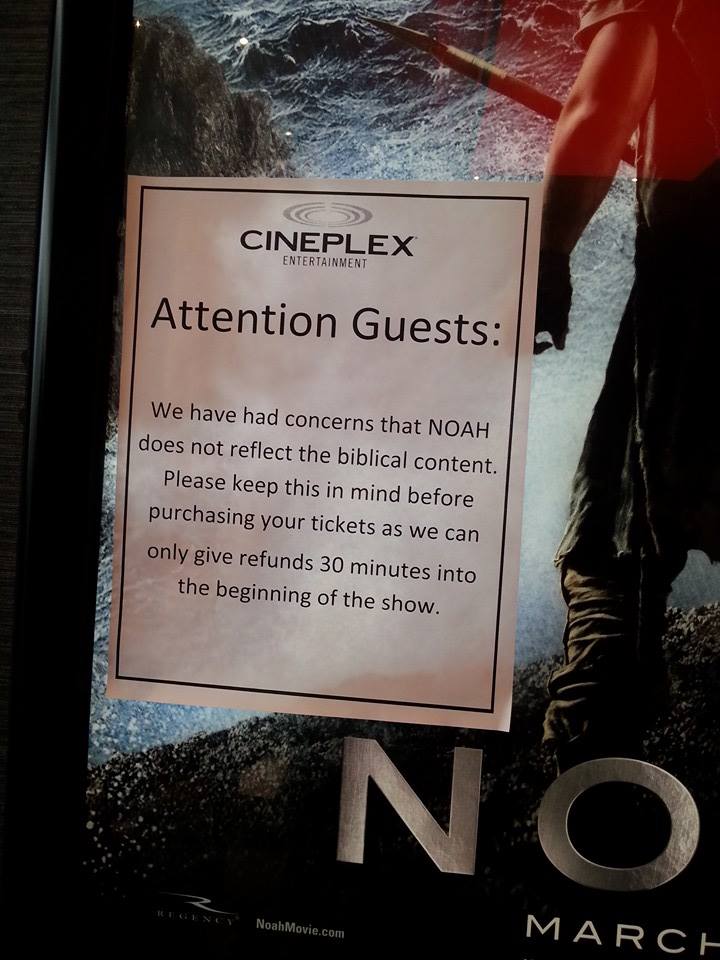
One of my favourite responses was this one:  It’s a sign put up at a movie theatre in Abbotsford. noah

“Attention Guests:

We have had concerns that Noah does not reflect the biblical content.  Please keep this in mind before purchasing your tickets as we can only give refunds 30 minutes into the beginning of the show”

People saw the movie and asked for a refund because it they thought it didn’t follow their understanding of 3 chapters in a book written thousands of years ago.  I get it that we sometimes end up seeing movies we don’t like, but to ask for a refund?!?  That’s awesome.  I guess there are a bunch of thrifty Mennonites in Abbotsford or something.

Another one of my favourite posts on the internet was this one:

noahs ark

“You express concern that the movie Noah wasn’t faithful to the text, and yet you’re okay with decorating your baby’s room like this?  Where are all the wicked humans who thought of evil all the time?  Where is the God who destroys the Earth?  Where are all the floating corpses?  And why is the Panda wearing a ribbon on her head?”

I love it.  I haven’t seen the movie, so I’ll stop talking about it, but if you have seen it and want to talk about it, you can talk to Mel.  He’d love to talk to you about it.

But, movie aside, we still have this story of Noah and the Flood.

God saw how wicked the humans were, regretted making them, and wants to destroy them.

Genesis 6:7:  “I will wipe from the face of the earth the human race I have created—and with them the animals, the birds and the creatures that move along the ground—for I regret that I have made them.”

God regretted making us?  I think that is one of the worst things we can say to our children.  “I regret having you.”  That cuts deep.  Don’t say that to your kids.

But here God regrets us.  So he seeks to destroy us.   Which raises big questions as to what kind of God is this?  But we’ll get there in a bit.

God wants to destroy humanity, except for Noah and his family.  He tells them to build a boat and fill it with animals and then go for a 40 day boat ride with them so they can survive the flood.

After we’re done reading this, we start asking some interesting questions:  How did he feed the animals?  How did he fit sixty thousand vertebraes on the ark?  Did Noah have the one million species of insects on board?    How did animals reproduce if there were only two left of a kind?  Did the baby animals end up mating with their siblings?  What if one platypus went this way and one went that way and they never found each other again?  What if right out of the ark the wildebeest gets eaten by the crocodiles?  And the 40 days of flood water… Was it salt water or fresh water?  And an elephant poops 300 lbs a day, so times by 2 elephants… 600 lbs a day, times by 40 days… Did Noah and his family actually shovel 24,000 lbs of elephant poop off the side of the boat?  Oh, so many questions to ask.

But as much fun as it is to think of all the theoretical problems of Noah’s Ark, I think if we do this, we miss the point of the story.  I think that in our effort to take the story seriously, we often end up taking literally, because when we read history text books, that’s what we do.  This historical event happened, Alexander the Great went there, this volcano erupted, some army fought some war, Louis Riel formed a province, and then in the summer of 2014 we all found out that RM of Hanover was never really dry in the first place.

But here’s the thing about the story of Noah and the Flood.  It was never written to be a historical depiction of what happened.  There wasn’t anybody there writing down what Noah said to his wife about the smell on the Ark.  The flood story, the version that we have today in our Bibles, was most likely written down thousands of years AFTER the event happened.  That’s like you and I trying to write the history of the Roman Empire.  Considering that I can’t remember people’s birthdays without Facebook  reminding me, some of those details might be a bit blurry.

But that’s okay, because you wouldn’t expect me to get it all the details right as to what actually happened, right?

But what you WOULD expect me to do is to get the important parts right.  And THAT’s why we are reading the story of Noah and the flood to this day.  Because there’s something important in there that we’re not supposed to miss all these thousands of years later.

What is that important thing?

Well, did you know that there are flood stories in other Ancient Near East religions?   The Sumerians had flood stories, the Mesopotamians had flood stories, the Babylonians had flood stories… Back then, everybody had flood stories.  Some of the stories even had people building boats to escape the floods.

Everyone was talking about floods.  Because floods were uncontrollable.  Floods were unpredictable.  Floods killed.   Floods were bad.

And how would a person back then make sense of these killer floods?  Well, the Gods sent them.  The Gods sent the floods as part of their anger. God sends a flood because God is mad.

Think that sounds stupid?  Yeah, it does.  But to this day we still hear people attributing hurricanes and tornadoes and disease  and death to God.  People call it a warning, or a wake-up call, or a punishment for unconfessed sin.  Some still call it God’s wrath.  The insurance companies call it an act of God, and then you find out you’re not covered.  This line of thinking makes God sound petty and vengeful and is actually more about karma than grace, but we hear it all the time.

The same is with the flood stories we find in other Ancient Near Religions:  The gods are angry, and the result of their anger is chaos and death in our world.

And that’s exactly how the flood story we find in Genesis starts.

God is angry with humankind, God regrets making them, God is going to destroy them all with a flood because of that anger.   Everyone had heard this story before.  They all knew how it was going to end.

But then, in this flood story, something different happens.  Something monumental.  Something so important that it was probably worth writing down so that we’d never forget it.

A rainbow happens.

Gen 9:11 – I establish my covenant with you:  Never again will all life be destroyed by the waters of a flood:  never again will there be a flood to destroy the Earth.

And then the rainbow is the sign of this covenant.

Rob Bell puts it best: 

“This was not how people talked about the gods.
The gods are pissed off-that’s how people understood the gods.
But this story, this story is about a God who wants to relate-
A God who wants to save-
A God who wants to live in covenant…

This story is about a new view of God.

Not a God who wants to wipe people out,
but a God who wants to live in relationship.

So yes, it’s a primitive story.

Of course it is.
It’s a really, really old story.
It reflects how people saw the word and explained what was happening around them.

But to dismiss this story as ancient and primitive is to miss that at the time this story was first told it was a mind blowing new conception of a better, kinder, more peaceful God who’s greatest intention for humanity is not violence but love.”

This is the important thing.  This God, Noah’s God, our God, is about relationship.

This God, as Father, Son and Holy Spirit, IS relationship.

This God is in relationship with God’s children here on Earth.

This God invites us to live in relationship with each other.

This God invites us to relationship with our neighbours, both near and far, the ones like us and the one’s not like us, the ones we love and the ones who drive us crazy, the ones we’ve known for years and the ones who sit near us in church but we still don’t know their names.

We are invited to relationship.

One of the things that I love about Grace Mennonite Church is that there is a high emphasis on relationships. That emphasis has been there since its beginning, and continues to be important for us over 50 years later. We value relationship.

Last week, Mel invited us to remember it is God that we serve when we go to work.  Next week, we’re going to be looking for the work of God in the face of injustice, violence, and oppression, and invite ourselves to find out where we fit into that story.

But this week, the invitation is for us to enter into deeper relationships with one another and our world.

Next week is our fall fellowship lunch.  Come downstairs and sit with someone you don’t regularly sit with.  And if you can’t come next week, October 19th is our Thanksgiving lunch as well.

The Sisters of Grace group is planning a women’s retreat in the fall.  Take the risk and sign up, or even better, sign up and invite someone who isn’t going.

If you consider yourself a young adult, in November we’re hosting a Sabbath weekend of prayer, silence, and contemplation, plus we eat good food.

If you love to serve, Mel will be organizing a week of service with Mennonite Disaster Service.  Obviously helping rebuild homes and lives is a highlight, but so is spending time with people from Grace whom you might not otherwise.

Our Spiritual Guidance team will be hosting 6 evenings starting mid-October of guided discussions with guest speakers as we talk about sexuality.  Come and listen and learn and share and ask deep questions as a church community committed to following Jesus together.

It’s harvest time.  A great group of faithful gardeners always have room for more hands as they harvest a crop of vegetables for Soup’s On Wednesday nights.

We are hoping to host a group from Pauingassi again this fall.  Come and listen and learn and laugh and adopt a posture of humility with our First Nations brothers and sisters.

Budget some extra time to spend here at church on Sunday mornings, grab a cup of fair trade coffee, and join the conversations we often have as part of Christian Formation time.  Or at the very least, grab your coffee and be brave and say hi to someone that you don’t know very well.

Join up with the community of people who make sandwiches for school kids on Monday mornings, or help cook food on Tuesday afternoons for Soup’s On, or join up with the groups of Gracers who create space for people to encounter God at nursing homes.  Sure, you get to “do” some good things.  But you also get to do it with some pretty cool people.  You get to invest in relationships.

You’re invited to relationship with each other, as God’s church here.   Because God invites us to live in relationship with each other.  Because God is in relationship with us.  Because God, as Father, Son, and Holy Spirit, IS relationship.  Because this God, Noah’s God, our is all about relationship.

Amen.

Anti-Gay, Judgmental, and Hypocritical? On Weightier Matters of the Law…

“Woe to you, religious leaders.  You shut the door on people.  You make new converts twice the children of hell as you are.  You blind guides.  You snakes and brood of vipers!  How will you escape being condemned to hell?”  (verses from Matthew 23)

What a great, uplifting set of verses we heard this morning!

As someone who might be considered a religious leader, these words are especially uplifting. But, once again, I am reminded that the only people Jesus specifically “sends” to hell are rich people and religious leaders, and I probably fit both of those categories.  Comforting, isn’t it?

Why does Jesus have such harsh words here for religious leaders?  What’s going on?

Let’s go on a summer road trip first – Let’s start in Canada, then the USA, then Italy, and then Brazil, and then back to the USA and Canada.

First Canada:  I’ve said these words before here, but they’re worth repeating – The top 3 reasons why young people across Canada are staying away from church are because they see the church as:

Number 1 – Judgemental

Number 2 – Hypocritical

Number 3 – Exclusive

It’s quite similar in the USA.

A recent poll asked young non-Christian Americans to describe Christians.   Their answers?

Number 1 – Anti-Gay

Number 2 – Judgemental

Number 3 – Hypocritical

That’s not very flattering, is it?

To quote Shane Claiborne, we have a bit of an image problem, don’t we?

People who don’t go to church don’t have that many nice things to say about us.  It might appear that the world doesn’t like our religion.  It can sometimes even be perceived as hostility towards Christianity.

And then let’s cross the pond to Italy, and take a look at Pope Francis.  Now, you may not be following this guy, but hokey smokes, the guy makes a good pope.  He was elected pope last year, and almost immediately he has taken the world by storm.

For example, let’s go from Italy to Brazil.  Last summer, some 3 million people were gathering in Rio je Janeiro for World Youth Day with the Pope.   As 300 Mennonite youth from across Canada gathered for the Fat Calf Festival, we watched news clips of the party on Copa Cabana beach that we were missing.

Everywhere he goes, he gets treated like a rock star.

He gets praise from both religious and secular commentators.  He always seems to be hugging a disabled child, washing the feet of prisoners, embracing a disfigured person, or making compassionate comments about a marginalized people group (Merritt).  He lives in the guest house of the Vatican, he’s begged for forgiveness from clergy sexual abuse survivors, and he secretly sneaks out at night to spend time with people who have found themselves homeless.  And then he says that he finds the hype around him offensive, and that’s just a normal guy.  Whoa.  No wonder everywhere the guy goes, people swarm him.

I love the guy.

And you know what?  If we go back to the USA, we find something remarkable:  So do Americans!

A full 75% of Americans, regardless of their faith background, look favourably on the Pope.  Protestants love the guy.  Catholics really love the guy.  Mennonites think he’s a Mennonite.  Atheists love the guy.  Pope Francis was the most talked about person on the Internet last year. The Advocate, a leading GLBT magazine, even named Pope Francis “person of the year” after he said “If someone is gay and seeks the Lord with good will, who am I to judge?”  75% of Americans look favourably on Pope Francis.  And I think you can include me in those 75%.

So, on one hand, we have this attitude of “Christians are anti-gay, judgemental, and hypocritical.”  And on the other hand, we have this attitude of “We love the Pope!”  How can this be?  What’s going on?

Well, I think Matthew 23:23 is what’s going on.

In the midst of the woes and warnings and condemnations that Jesus gives religious leaders, one verse helps explain what’s going on.

Matthew 23:23 – Woe to you, teachers of the law and Pharisees, you hypocrites!  You give a tenth of your spices – mint, dill and cumin.  But you have neglected the more important matters of the law – justice, mercy and faithfulness.

As Jonathon Merritt from CNN puts it,

People are not intrinsically allergic to Christians, but rather certain expressions of Christianity. The pope’s popularity helps us understand exactly which types of Christianity people resist.

People accept Christians who want to serve society.

People resist Christians who want to be served by society.

People accept Christians who are as clear-eyed about the failures of their community as well as others’.

People resist Christians who are partisan and tribal.

People accept Christians who are compassionate and speak with humility.

People resist Christians who are cantankerous and speak with hubris.

People accept Christians who advocate for the marginalized.

People resist Christians who seek power to marginalize others.

Or, he puts it another way.  Most people dislike Christian jerks not because they are Christian, but because they are jerks.

Let’s go back to the top descriptors of Christians in North America by non-Christians: Anti-gay, judgemental, hypocritical, and exclusive.

I’m actually quite grateful for the criticism.  I might even call it constructive criticism, because it’s a criticism of some of our worst parts.  It’s a wake-up call, a reminder of what not to be, of who not be, or how not to act.  Jesus had harsh words for the religious leaders for a reason.

And I’m grateful for the public’s love of Pope Francis.  It’s a celebration of our best parts.  It’s a wake-up call, a reminder of who to be and how to act – Care deeply about mercy, justice and walking humbly with our God. It’s a call for us to be known by what we are for, not what we are against.  Jesus said that these are the more important matters of the law for a reason.

Because as we live in this world as followers of Jesus, “It makes little difference to most people whether we proclaim that God agrees with our personal decisions.  But it makes a difference to everyone in our communities whether we stand for justice, love mercy, and keep faith with God and neighbour.”  – Jonathon Wilson-Hartgrove

On Israel & Gaza (Hamas) & Jesus

I’ve been slow to wade into the conflict between Israel & Gaza (Hamas).  Partly because it’s remarkably polarizing, partly because it’s remarkably complex, and partly because much has already been written about it by much more knowledgeable people than me.

There’s a lot that we could look at.  We could simply focus on the death toll (as of August 5, nearly 1900 Palestinians vs. 67 Israeli’s).  We could look at the ratio of militants vs. civilians who have died (as of August 5, 3 Israeli civilians vs. approximately  1400 Palestinian civilians (UN numbers)).  We could look at the long, complicated history of the Middle East.  We could look at the number of Palestinian children who have died from airstrikes and tank fire (Pause.  Re-read  that last sentence.  Once you’re done throwing up in sheer revulsion, light a candle and pray, “Lord, have mercy.”).  We could look at which governments are funding a certain side.  We could look at the violence and injustices being perpetrated by both sides before and during the conflict.  We could look at the all the wonderful people in both Israel and Gaza who are working towards peace and reconciliation and are condemning the violence around them.

All of those are worthy topics.  And much has been written about them, although we could use more of the last one.

I think, though, that I will write about my embarrassment of being a Canadian Christian in this conflict (Please forgive me for making this terrible conflict remarkably small and selfish).

I’m embarrassed because at first glance, many Christians, including politicians, church leaders, and social media users, have unequivocally taken the “side” of Israel.

It’s like they have completely forgotten Jesus in all of this.

Jesus was born in the midst of massive oppression by the Romans.   His birth was the cause of a massive genocide (think of all the dead children we don’t mention on Christmas eve that Herod killed).  He grew up in a conflict zone.

As an adult, Jesus had a chance to join a side.  He could have joined the ruling side, the ones with power and privilege, the ones who made the rules, but he didn’t.  He had supper with sinners, outsiders, prostitutes, tax collectors, the down-and-out, the nobodies.  He made the ruling elite quite mad, criticized their power, told them they were going to hell, and subverted their religious and economic systems.  And they eventually killed him for it.

But he also had the chance to stick it to the powers.  He could have joined the violent rebels, fought for the oppressed, claim political power and be named king, but he didn’t.  He healed the servant of a Roman soldier, rode a donkey instead of a war horse, told his followers to put away their swords, and healed the physical damage done by his followers.  In the face of his own death, he chose to not fight back, but rather to die.

And have we completely forgotten the teachings of Jesus?  Love your enemies?  Do good to those who hate you?  Bless those who curse you?  Blessed are the merciful?   Turn the other cheek?   Pray for those who persecute you?   Blessed are the meek?

Even Paul instructs the church in Rome (the middle of the empire where Nero was using Christians as torches for his garden parties) to bless those who persecute you, do not repay anyone evil for evil, do not take revenge, and to feed your hungry enemy.

Even before Jesus, have we completely missed the fact that the Old Testament teaching of “An eye for an eye” was actually a groundbreaking, revolutionary teaching that was intended as a limitation on violence?   It’s no longer “a life for an eye,” or “a family for my brother”, but simply a tooth for a tooth? (Note:  Feel free to insert the numbers 1900 and 67 here.  It’s applicable).

But when we unequivocally take one side of a conflict, I think we’ve missed Jesus.

Because I think Jesus would be on the side of peace and justice and shalom and right relationships, and against all violence, oppression, and dehumanization wherevewho would jesus bombr they are.

I don’t think Jesus would be flinging rockets, capturing soldiers, dropping bombs, driving a tank, giving warnings about where what he was going to destroy next, or trying to kill people in general.

I think Jesus would be in the hospital, healing the victims of war.

I think Jesus would be in the refugee camps, feeding the thousands.

I think Jesus would be eating ice cream with children, regardless of where they were born.

I think Jesus would be in the bomb shelter or the designated “safe” zone, condemning the violence in our hearts and in our world, and reminding us all to not be afraid.

I’m embarrassed when Christians in Canada unequivocally support one side of a convoluted, violent conflict.  Because then we’ve let our politics come first before Jesus.

Or, as Gandhi essentially said, “I sure love Jesus, but the Christians seem so unlike their Christ.”

Lord have mercy.

Kyle

PS – If you want to read a great book, read “I Shall Not Hate” by Dr. Izzeldin Abuelaish, a Palestinian doctor whose daughters were killed by Israeli forces in 2009.

PPS – Dr. Abuelaish is trying to bring 100 of the most seriously wounded kids from Gaza to Canada for healing.  Learn more and donate here:  www.heal100kids.com

(Feel free to leave a comment.  I’ll leave them open until if/when it gets out of hand).

Unused Gym Memberships, 7-11, and Silence

A big thanks to Mark Yaconelli and Frank RogersKurt Willems and Phileena Heuertz (who use Dallas Willard, Thomas Keating, and Marshall Rosenberg) for their words that helped shape mine.

_____________________________________________________

I was having coffee with a young adult a while ago.  We were sitting outside at Oak Ridge, the sun was shining on us, the wind was keeping us cool, and our lattes were keeping us alert.   They sipped their drink, and said “I’ve pretty much quit everything churchy, and I’ve never felt better.”

That’s an intriguing way to start a conversation with a pastor, isn’t it?

The young person went on:  “I’ve stopped attending church regularly, I’ve pray less, I’ve stopped trying, I’ve stopped giving as much money as I used to, I’ve stopped trying to get involved in my church, I’ve stopped trying to be friends with people because I’m supposed to… And I’m loving it. I feel free.”

Well then… I had never had that type of conversation before.

But since then, it’s stuck with me.  And I’ve seen versions of it pop up in all sorts of places.

As we’re getting ready to get on some float planes and heading up to Pauingassi First Nation for another week of Family Camp, I’d be lying if I told you I was 100% excited.  Maybe 80%, and that number is increasing every day, but it’s hard in the face of all the incredible challenges that face the community.  There was another suicide 2 weeks ago, making it 3 in 6 months.  If you extrapolate that number to Steinbach, we’re talking about a suicide every other day.  Let alone the continued problems of bootlegging, binge drinking, and  violence. 

I ask questions like, “What’s the point?”  “Why are we doing this?” “Does it make a difference?”  And then I realized that it would be much much easier to sit in my back yard or go camping with my friends in the Whiteshell. 

And then I feel guilty… like really guilty.  Jesus tells his followers to deny themselves and take up their cross and follow him, and I preach that all the time, but sometimes, I wonder what it would feel like to simply check out and go to the cabin.

This also shows up sometimes in the longevity of the work that we do, both at church, at work, or in the other ways we volunteer.  The idea of public speaking may scare us, so we offer our time and energy as church trustees, fixing the roof, or as Sunday School teachers, teaching our children.  We join community events and boards and fundraisers for all sorts of great causes, like addressing homelessness, community runs, the Chamber of Commerce, the museum, funding for researching a cure cancer, or coaching minor hockey and soccer.  

 But after a while, we find ourselves asking questions about what it’s all accomplishing.  I mean, sure, coaching kids and raising money and making sure the church’s roof doesn’t leak are all very good things.  But what kind of lasting change do they make?  Is all our effort and time and energy and sweat and money we put into these things worth it?   What do we do after 20 years of serving on church committees and our children choose to go to a different church?  Or attend the church of the Mennonite mattress?  What do we do if we if the kids that we invest in make really bad choices?  What do we do when the next, exciting initiative comes our way?   What do if we know what we’re supposed to do, but simply don’t have the energy or desire to do it anymore?   What if we’re tired of the guilt, both internal and external, of what we “should” be doing?

Some of us try harder.  We try harder to not sin, to not give in to our selfish impulses, to be a better Christian.  But we all know that trying harder doesn’t often result in the change we want to see.  Sometimes it does, but often it leads to unused gym memberships and sneaking chocolate during Lent.

Some of us try harder to love our neighbours.  We try harder to be more loving and to meet more people and love our enemies and fix more roofs and join more committees.  Often we end up just wanting to quit and go on vacation and try to not live in so much guilt.

Mark Yaconelli explains it like this: 

 “Compassion, as is widely known, is at the core of Christianity. Jesus summed up all of his teachings with the commandment to love God with our entire being, and to love our neighbors as ourselves. Indeed, his call is more radical than that. Loving our neighbor involves extending compassion not only to the wounded and needy, the demonized and despised, but also to people who revile, violate, and persecute us. ‘Love your enemies,’ Jesus invites, ‘bless those who curse you, pray for those who persecute you, and show compassion to those who hate and do evil.’

This radical ethic of compassion seems extraordinary to the point of being unattainable—or attainable only to the gifted few. When the Amish find the capacity to forgive a man who has killed their schoolchildren, when Nelson Mandela finds it in his heart to invite his jailor of twenty-seven years to stand at his side during his inauguration, when a Palestinian woman who has lost her son in a terrorist bombing raises an Israeli boy, and raises him as a Jew, it shimmers with the miraculous. Ordinary folk like us stand in awe, amazed and inspired. We also can feel indicted and shamed. For the truth is, loving our enemies is excruciatingly difficult.

Thomas Keating says that this is the difference between faith conversion and the spiritual journey.  At the time of our conversion, we ask the question, “What can I do for God?”  We sing the song, “Here I am Lord”, and we get busy.   Teaching Sunday School and going to Pauingassi and coaching hockey and  feeding people who have limited access to food.  But after a while, we’re left with wondering how in the world we’re supposed to attain and sustain this radical ethic of love and compassion…

The spiritual journey begins with the question, “What can God do for me?”

And it’s not meant as a narcissistic or selfish question, where we ask God for a million dollars to help lose a few pounds or to help us find a parking spot, but rather a question acknowledging that what we desperately need God to do for us is to transform us from what we are today into what God intends us to be.  (Thanks Phileena Heuertz, from Pilgrimage of a Soul)

It’s a shift from understanding ourselves as Human Beings vs. Human Doings. 

Is the Christian faith about doing certain things?

Or is the Christian faith about being a type of person who naturally does certain things? 

And what’s the difference?

Great example:  One of my pastor friends used this as an example:  She said,  “I’m paying for my Slurpee at 7-11.  They give me too much change.   I used to think, “Do I or don’t I give it back.  Well, I should.  So I will.”  But now, I just do.  Being honest is now part of who I am.”

We heard similar language when the Amish in Nickel Mines forgave the man who killed their children.  Almost immediately, while they were still trying to figure out what happened, members from the Amish community went to the man’s family’s members to sit and cry with them.  I don’t think that they had to make a choice to do it.  I think that it was just an out-flowing of who they are.   When you pray every day “Lord, forgive us our trespasses as we forgive those who trespass against us”, I think it simply becomes part of who you are.  It still wouldn’t have been easy, it wasn’t condoning the terrible violence done to their families, but it was seeking reconciliation and restoration where possible.  

All these great Christian virtues – forgiveness, love for enemies, solidarity for the marginalized and oppressed, responding to evil with creative non-violence, generosity – often we treat them as goals, when really, we should be treating them as fruit.  We should work on becoming faithful followers of  Jesus, and the fruit will grow.  Or, as Dallas Willard puts it, “Jesus invited people to follow him into that sort of life which behaviour such as loving one’s enemies will seem like the only sensible and happy things to do.  For a person living that life, the hard thing to do would be to hate the enemy.”

When we’re asking the question, “What can you do for me God?,” we’re putting ourselves in a place where our actions – teaching Sunday school, sharing our money, making sure there’s a roof on the church, flying to Pauingassi, fundraising for a cure to cancer, ensuring every kid can afford minor hockey or band trips, loving our enemies, standing in the margins with those who have been placed there – flow out of what God is doing inside of us. 

To use the tree analogy, because we’re rooted in something deep, because we’re nurtured something bigger than us, we’re able to bear fruit.

 “What can you do for me God?”

I also think it’s a question that we don’t like to ask.

Because in order to try to get an answer for it, we must sit.  We must sit in silence.  We must sit and listen to the all the competing voices inside of us.  We must tend to our souls.   We must admit that there are deep places  of fear and anxiety and pain within us.  Because almost all of our outer actions are reactions to our inner pains, fears and anxieties.  Sitting in silence is an invitation to acknowledge the logs in our own eyes, and pray for them.

And sitting in the midst of the logs in our eyes, those fears and pains and anxieties, those deep wounds, isn’t always pleasant.  But when we acknowledge them, and offer them to God with the words “Lord, have mercy,” then we are starting to understand the spiritual life.  Then we are starting to ask the question, “What can you do for me God?”

So we sit, and light a candle, and pray.  Often in silence, without answers.  But it’s here that we begin to trust that God, the one who goes after the one lost sheep, the one who is personified as love, meets us to tend our wounds and heal us.

Back to my life giving conversation at Oak Ridge over our lattes… “I’ve stopped doing churchy things, and it feels great.” 

This is how I more or less responded (or what’d I say now that I’ve had some time to think about it).  “Good to hear.  I think that, when you figure this out, you’ll find your way back into doing the things that you stopped.  You’ll find yourself participating faithfully in a faith community, you’ll find yourself looking out for people who are alone, you’ll find yourself giving more of your money away, you’ll find yourself caring about the least of these… I think, though, that you’ll be rooted in something deeper.  You won’t be compelled to do it out of guilt, or shame, or because you “should” be doing it.  You’ll be doing it out of a deep spirituality where it’s not a choice, but rather simply a way of life.  Where the love you give the world is the fruit you bear from following Jesus.”

I’m going to light a candle, and I’m going to invite us all to sit in silence.  And as we sit, our minds will probably be busy bombarded with thoughts, as you exhale I’d invite you to meet them with the words, “Lord, have mercy.”

___________________________

The above was preached at Grace Mennonite Church on June 22, 2014.  

Some thoughts on conversion, communion, and cats.

The following is a short sermon from Pentecost, where we celebrated baptism, membership transfer, and communion.

___________________________________________

These are the words from Anne Lamott’s, as found in her book,  Travelling Mercies.

“After a while, as I lay there, I became aware of someone with me, hunkered down in the corner, and I just assumed it was my father, whose presence I had felt over the years when I was frightened and alone. The feeling was so strong that I actually turned on the light for a moment to make sure no one was there–of course, there wasn’t. But after a while, in the dark again, I knew beyond any doubt that it was Jesus. I felt him as surely as I feel my dog lying nearby as I write this.

And I was appalled. I thought about my life and my brilliant hilarious progressive friends, I thought about what everyone would think of me if I became a Christian, and it seemed an utterly impossible thing that simply could not be allowed to happen. I turned to the wall and said out loud, “I would rather die.”

I felt him just sitting there on his haunches in the corner of my sleeping loft, watching me with patience and love, and I squinched my eyes shut, but that didn’t help because that’s not what I was seeing him with.

Finally I fell asleep, and in the morning, he was gone.

This experience spooked me badly, but I thought it was just an apparition, born of fear and self-loathing and booze and loss of blood. But then everywhere I went, I had the feeling that a little cat was following me, wanting me to reach down and pick it up, wanting me to open the door and let it in. But I knew what would happen: you let a cat in one time, give it a little milk, and then it stays forever. So I tried to keep one step ahead of it, slamming my houseboat door when I entered or left.

And one week later, when I went back to church, I was so hungover that I couldn’t stand up for the songs, and this time I stayed for the sermon, which I just thought was so ridiculous, like someone trying to convince me of the existence of extraterrestrials, but the last song was so deep and raw and pure that I could not escape. It was as if the people were singing in between the notes, weeping and joyful at the same time, and I felt like their voices or something was rocking me, holding me like a scared kid, and I opened up to that feeling–and it washed over me.

I began to cry and left before the benediction, and I raced home and felt the little cat running at my heels, and I walked down the dock past dozens of potted flowers, under a sky as blue as one of God’s own dreams, and I opened the door to my houseboat, and I stood there a minute, and then I hung my head and said ‘F— it: I quit.’ I took a long deep breath and said out loud, ‘All right. You can come in.’

So this was my beautiful moment of conversion.” 

_______

I love Anne Lamott. 

We find ourselves today celebrating practices that have been going on in faith communities for 2000 years: Practices of baptism, testimonies, joining the church, and communion.   2000 years!  This is bigger than us.  These are the practices of saints and sinners, of strong leaders and humble servants, of the faithful and the faithless, of popes and prisoners and priests and paupers.  These practices are bigger than any one of us.  These are the practices of Jesus himself. 

We find ourselves here, celebrating these moments, over and over again.  Some of us were baptized a long ago, and today we recall our own stories as we see the water.  Others of us marvel at how our testimonies have changed over the years.   Many of us speak with fondness  about this faith community, and how important it has been to our spirituality.  And we constantly remember Jesus when we participate in the bread and the wine.

We all have these stories.  And it’s through our practices that we find our stories being part of the big story, part of the long story, part of God’s story… A story of hope and healing, a story of grace and peace, a story of God redeeming the world, bit by bit.  This is the story that we find ourselves living in, over and over and over again.  Every time we share in a baptism, we share in joining a church, we share in communion, we find ourselves living in God’s story.

Sara Miles is one of my favourite authors, and writes the following about finding herself in God’s story (as found in Take This Bread).

“Conversion isn’t, after all, a moment.  It’s a process, and it keeps happening, with cycles of acceptance and resistance, epiphany and doubt.

 The faith I was finding was jagged and more difficult. It wasn’t about abstract theological debates.  It was about action.  Taste and see, the Bible said, and I did.  My first questioning year at church ended with a question:  Now that you’ve taken the bread, what are you going to do?’

Now that you’ve taken the bread, what are you going to do?

God is constantly moving towards us, sometimes like a cat, inviting us to participate in the Kingdom of God.  We come, we taste, and we see that the Lord is good.  So what are we going to do? 

May God guide us as we continue to find ourselves in God’s story of grace and peace.

Lord, keep us from speaking of love while hoarding the gifts you have given us. Make us full of discontent as long as there are brothers and sisters living and dying in hunger.

Our church invited people to live off of $5 for food a day. Below are my thoughts, my menu, and whether or not I accomplished what I set out to do.

___________

Monday:

7:15 – I want coffee.
8:15 – I miss coffee. I have a headache. But I found Tylenol with caffeine in it! Win-win! Or is that cheating?

9:00 – Went shopping. Buying food for myself AND my family at the same time was quite depressing. No meat, but I think I was able to do a decent job. We’ll just see if it lasts me until Friday. And seriously… How the heck am I supposed to buy toilet paper and toiletries with such few dollars?

10:30 – My head is pounding… I must be addicted to caffeine. And I ate every spare morsel off my apple.

Breakfast: Peanut Butter toast
Snack: Apple
Lunch: Can of tomato soup. I am staring longingly at my children’s food.

1:30 – I have given in and had coffee. This is a food security challenge, not a “kick the caffeine addiction” challenge. If all of my painkillers and the nap have not made my headache go away, and all I wanted to do was in my room and die, I figured it wasn’t worth it. I still need to go to work and be present to my family.
3:30 – My kids are snacking. I am not.
4:30 – Preparing two separate meals sucks.

Supper: Roast carrots, roast potatoes, and rice.
9:15 – At Boston pizza with my friends after my ultimate game. They are all eating food. I am watching them enjoying my water.

A note on my caffeine addiction. Often, we look at people who are on social assistance and think, “If they only spent their money this way, if they didn’t buy that, if they didn’t spend their valuable dollars feeding their addiction, they’d have more money for food.” Well, yes, that is technically correct. It comes across as awfully judge-y though, and I really wouldn’t want to be your friend if you’re just going to look down on my spending choices. But after hating being awake after a few hours of trying to kick a simple caffeine addiction, I understand a little bit more when people have to choose between feeding a stronger addiction or buying apples. What a crappy situation to be in.

Tuesday:

Breakfast: Peanut butter toast and banana.

Lunch: Leftovers from yesterday.

Supper tonight: Spaghetti with sauce. And I licked the spoon with sour cream on it.

I find myself getting lots of starches, and very bland food.
I find myself eating because I have to, not because I want to or because the food tastes great.

Wednesday:

Breakfast: Peanut butter toast and banana.

Lunch: I went to the city for work. My friend offered to buy me a burger lunch. I said I packed my own, being 4 pieces of bread (with peanut butter) and an apple. So we sat in a park, and I watched him eat his burger while he watched me eat my bread.

Supper: Potatoes, corn, rice.

9:00 – I gave in and ate cookies at a church meeting today. I’m trying to limit the amount of food I receive from my well-meaning friends. But I must learn to be less prideful and receive, because receiving enables someone else to give.

I bought 1 L of milk for the week, and am drinking one glass a day.

I find myself hesitating to eat the food I do have, for fear that I will run out. I am slowly shifting from a worldview of abundance to one of scarcity.

Thursday:

Breakfast: Peanut butter toast and banana.

Lunch: Potatoes, rice, corn.

Supper: Corn, spaghetti & sauce, and a glorious (really) can of beans. I could only eat half the beans, as the other half is for my Friday lunch.

I’m hungry. And I miss butter.

I think I have the challenge harder than most, as I am preparing regular meals for my family in addition to my meals. So I get to watch them eat burgers and taco salad and cheese and strawberries. And I get to put their leftovers in the garbage.

Friday:

Breakfast: Peanut butter toast and banana

Lunch: ½ can of beans, and I ate 2 cookies my mother in law made. And a brown apple (all my apples are now brown, but I can’t just throw them out).

Supper: It was supposed to be 2 carrots, 1 potato, and rice. But I was rushed to get my kids to swimming lessons, so I ended up stuffing my face with perogies and farmer sausage. It tasted sooooo good.

This $5/day challenge is kind of rigged. I have used way more stuff that I would have had purchase than simply food. I’ve used: saran wrap, Ziploc containers, toilet paper, shampoo, body wash, hand soap, toothpaste, pain killers, cough syrup, dish soap, and tin foil. That’s more than 25 right there, not including my stove, my fridge, my freezer, my phone, and the transportation to get the food (I live 3 miles from the nearest grocery store).

I’m amazed at all the great conversations that have happened because of this challenge. And many people NOT on income assistance have told me that their meals aren’t that different from mine, or that they spend a similar amount on food. And I think this is great. I think some of the differences, though, come with the freedom that choice offers us. When we are able to buy more food (such as pizza with friends after an ultimate game), or if we eat all our apples because we hungry now (or throw out the apples because they’re brown and gross), we’re able to go to the store and buy more. I’m struck by the importance of choice. If you don’t have the choice, living “simply” can be quite paralyzing and depressing.

Looking back, did I accomplish my goals?

1) Raising awareness: Heck yes. I’ve had lots of great conversations. Our little website has over 1000 views. Many of us didn’t know about the $3.96/day allotted to a single person on social assistance. Now we do.

2) Understand a different reality: Sort of. On one hand, I generally was hungry, ate brown apples, ate a lot of rice, and did my best to live off of $5/day. But on the other hand, 5 days is short, I have bacon and ribs in my fridge for the weekend, I had coffee and used toilet paper, so I understand that even me “depriving” myself was quite contrived.

3) Better advocates: Ummm… We’ll see. Maybe I’ll fire a letter off or two. But I’m not sure if that’ll work. I have to see where this all leads me in the future.

4) Examine my own decisions: Yup. I have a lot of money to spend. And I spend it quite well. How much do I need, and where my money goes, are probably life-long questions. But maybe acknowledging my wealth and my privilege are a good first step.

5) Spiritual Discipline: Sort of. I didn’t have to pray for food, as I knew this challenge was temporary. But I was a bit more thankful for the food I did eat. I am reminded of my friends in Zimbabwe who, 10 years ago, kept telling me that “Wo/man doesn’t live on bread alone.” But it’s an awfully important part. I have some thinking and praying to do about my involvement in food security in my community.

Thanks for following along and/or joining!

“Lord, keep us from speaking of love while hoarding the gifts you have given us. Make us full of discontent as long as there are brothers and sisters living and dying in hunger. Amen.” – Common Prayer: A Liturgy for Ordinary Radicals, March 9

Design a site like this with WordPress.com
Get started