Optical illusions, Casseroles, and Moose

This morning, we are celebrating Epiphany.  Technically, Epiphany is on January 6, but we moved it up to today because it worked better with our preaching schedule.

When I started as a pastor 11 years ago, I was given the job of preaching on Epiphany, and I remember asking, “What’s Epiphany?” as I really had no idea.

There are two things going on at Epiphany.

The first is a more technical understanding.  An epiphany is a sudden or striking realization.  It’s an “Aha!” moment.   A light bulb turning on.  A “Eureka” moment! A moment where we fog is lifted and we now see.

Like this for example. mainimage

Do you see an old woman, or a young woman?

And then, that moment where you see both of them… Ah!  There it is!

That’s an epiphany.

The second thing about Epiphany Sunday is it’s where we celebrate the magi from the East coming to visit the child Jesus, and bring him frankincense, myrrh, and gold.

Now there’s a lot of lore and myth around the story of the magi.  We call them wisemen, magi, kings, astrologers… We talk about three, but their number is unknown.  Over the centuries we’ve even given them names! Gaspar, Balthasar, and Melchior!  (Not exactly high on the baby names of 2015 though).

For this morning, it doesn’t really matter.  We’re just going to roll with the plot of some people from afar came and visited Jesus.

But, a quick aside.  There’s a joke going around on social media every Christmas.   Have you ever wondered what it would have been like if the three wise men were women?  They would have asked directions, arrived on time, helped deliver the baby, cleaned the stable, made a casserole, brought practical gifts, and there would be peace on earth.  Har har.  Very funny. I resent this, as I make a mean casserole, helped deliver my kids, and can change a diaper with my eyes closed.

Okay. Back to the journey of the magi.

But let’s start with the word “journey.”

I like the idea of journeys. It’s a word that signifies experience. It signifies adventure.  It’s a word that signifies to us that the destination isn’t the only goal.  That how we get there is partly the point.  It helps us understand that we’ve never truly arrived, that we’ve never finished, that every step is part of the experience.

When I go canoeing, I love getting to the campsite for the day.  I love setting up the tent and making a fire and watching the sun go down.  I love watching the sun rise in the morning and showing my kids the beavers swimming by.

But the campsite isn’t the only goal.  I also love getting to the campsite.  Where every corner you turn you look for a moose in the shallows.  Where you see a fish a jump close to you.  Where you see fallen trees and cliffs and bays waiting to be explored.

In a journey, every part of it is included in the experience.

We also use this language for faith.  Not a destination.  A journey.

It’s where we understand that being a disciple of Jesus, that growing in our faith, that learning to love and forgive, learning to trust God, is a continual process. We’ve never really arrived.  We can usually be sure that if we thinking we’ve arrived is a sign that we haven’t.  God is never really done with us, and very few of us claim to have this whole spirituality thing nailed down, or consider ourselves experts in grace and peace, so we use the language of journey.  Where every new day is a new challenge and opportunity.  Where every time we stray from the path, we can get back on the path.  Faith journey has become part of our vocabulary.

Years ago, I was taking a CMU course with a prof from Harvard, Sharon Daloz-Parks, and besides being an incredible teacher, she said something that has stuck with me ten years later.

She said that while she understands why we use the word “journey” to describe our faith, she found it to be a bit to individualistic and self-centered. That faith is my journey with God, and really, if this is my journey, who are you to criticize it?

This, I believe, has led to many of us in Canada say, “Well, we’re spiritual, but not religious.”  Which, on one hand, I totally get and understand and have respect for this. We believe that life is bigger than us an our individual successes and Boxing Day shopping, but we don’t want to participate in religious rites and rituals that don’t give us life.  But on the other hand, if you were to ask how our “non-religious spirituality” affects our lives, very few of us would cite extra giving, or volunteering, or mediation, or shoveling extra driveways, or loving our enemies.

When we make faith a journey only about ourselves and God, we risk people hiding behind the idea of God while exhibiting very little transformation in their lives.

**Note – Christians are also really, really, really good at hiding behind the idea of God while exhibiting very little transformation in their lives.  Heck, I’m pretty good at hiding behind the idea of God.**

So, my prof told us that instead of the word journey, she uses the word “pilgrimage”.

A pilgrimage is a trip to a holy site, and when we’re there, we encounter something divine that changes us. And then, we go back home, bearing gifts for our community.

A journey is about a trip and back.  A pilgrimage is about being changed and blessing our communities.

It’s like MCC’s SALT program that I went to Zimbabwe with 13 years ago.  SALT is an acronym for Serving and Learning Together, where they send young people around the world to work in a variety of NGO’s for a year. And when we got back, at our debriefing, they said to us.

“We kind of tricked you. We sent you to serve and learn, but really, while the serving you was great, if we really only cared about that, we could have hired locals to do the work you did with much for efficiency, since they understand the local language and culture.  But, what we really send you out to do was to learn. To learn about who you are and a bit more about the world and a bit more about God, and now that you’re going home, you’re going to take all that you learned and go and serve at home.  We thought about calling the program Learning and Serving Together, but the acronym LAST isn’t quite as good as SALT.”

You’re going to take what you learned with you and serve at home. A pilgrimage.

I now like to think of the journey of the magi as the pilgrimage of the magi, where they left everything to go and encounter Jesus, and because of that experience, their lives were never the same.

They allowed an encounter with Jesus to change them.  They had an epiphany, their “Aha!” moment. They re-orientated their lives around it.  They followed a star to a foreign land and met a king.

At Christmas time, it’s really easy to go on a journey to visit baby Jesus.  We have children’s concerts and Steve Bell played with the WSO and we have Christmas carols everywhere and churches fill up for Advent, especially on Christmas Eve.  We donate extra money, volunteer more, and go caroling with our friends.  We talk about the Christmas spirit being in the air.

So maybe a better question for us to ponder is, do we allow those experiences to change us?  What gifts do we bring back to our community?  Are we more generous?    Peaceful?  Loving?  Hopeful?

As we have for all our Advent services, we’ll have a slideshow of paths and offer a time of reflection.  As we reflect today, let’s ask ourselves,

Because of our pilgrimage to the manger on Christmas, what gifts are we bringing back to our community?


The Feast of St. Nicholas, the original Santa Claus

St.-NicholasOver the past few months, we at Grace been learning about the saints, and celebrating their faith stories by having mini-feasts in the foyer.

This morning, we are celebrating St.  Nicholas, the original Santa Claus.

Nicholas was born in 3rd century to rich parents in what is now Turkey. However, they died when he was as young boy and was raised by his uncle, a bishop.

His parents had left him an inheritance, and one of the first things that he did was promptly give it all away to the poor, the sick, and children in need.

He is remembered for quite a few acts of generosity, many of those giving little heed to his own life and safety. There’s a story of him standing between a slave owner and his property.  There’s another one of him standing between an executioner and his victim.  And one of him un-kidnapping a boy.

But the one is most remembered for is his rescuing of three girls from slavery.  Back in those days, families had to provide dowries for their daughters when they got married. The bigger the dowry, the higher up the socio-economic status they could marry. The smaller the dowry, the lower they could marry. No dowry meant no marriage, and were thus were usually condemned to live their lives as sex workers or slaves.

One poor father had three daughters, and was planning on selling them into slavery.  One night, Nicholas went to their house and threw three bags of gold in through the window so that the girls wouldn’t have to be sold.  The story goes that the three bags of gold ended up in socks that were drying by the fire, and that is why we, still to this day, hang our stockings by the chimney and put presents in them.

Although giving away our parent’s inheritance to strangers so they don’t have to live lives of destitution and slavery, is certainly a little more saint like than giving iPads and Xbox’s to our children.

And so, after our worship, enjoy your coffee and paperpnet, peppernuts, or however you say that word… enjoy it and celebrate the generosity of St. Nicholas.

** A big thanks to Shane Claiborne and Pete Enns and Wikipedia for the info and blatant plagiarism.**
 

A weekend at your in-laws, Grade 4, and the Return of the Jets

A third advent sermon on Ezra 1:1-4, 3:1-4, 10-13


The Old Testament is full of stories that tell the history of the Israelites.  It’s a library of books that were written by different people in different places for different reasons.  We have books of law and books of history and books of poetry and books of wisdom and books of prophecy.

And, every once in a while, if we’re able to take a step back, we notice something remarkable about these books.  They don’t only include the positive sides of the story.  They also include the negatives.  The criticisms.

For every good king we read about, there’s a prophet, saying, “Hey!  Wake up!  You’re still missing something here!”

For every good character we read about, we read about many of their dark sides and their penchant to lie, steal, kill, commit adultery, and ignore the poor around them.

We so desperately want to create categories of people and kingdoms and stories and label them as either good or bad, but if read these stories carefully, they just don’t give us a lot of fairy tale endings.

It takes as mature person to criticize their people while remaining among them.  It takes a mature person to criticize their faith, while remaining within it.  It takes a mature person to criticize their country, their church, or even themselves and their family, while remaining in it.

Today’s story is one of those stories.

So let’s pull out the old map, because trying to read these Old Testament stories without knowing what’s going on is always a bad idea.  photo.PNG

The Israelites were in Egypt as slaves.  Moses led the out, and then spent 40 years wandering the desert.  Then they set up a kingdom here, and couldn’t quite figure out how to get along, so it split into two.  Then the big bad Assyrians came and wiped out the Northern Kingdom.  Then the big bad Babylonians came and wiped out the Assyrians and took most of the Southern Kingdom back to Babylon, and this is called the exile.  And then the big bad Persians came and took over the Babylonians, and then Cyrus, King of the Persians, tells Ezra to lead the Jews home to go and rebuild their temple.

And this is where we pick up the story. After getting beaten up and kicked around and kidnapped and killed for the last two hundred years, the people were going home.

Oh yeah, we’re going home.  Kind of like how you feel after a long weekend at your in-laws.  Only imagine living there for decades. See ya!  It’s good to be home.

Only, we read in verse 3 that when they went home, the land wasn’t empty.  People who were left behind from the exile were still there.  Foreigners who moved in to the land, armies had left people there after conquest.  The land wasn’t empty, and Ezra and his people were afraid.  Afraid of the conflict that might arise.  Afraid that their hopes and dreams might be dashed.  Afraid that their safety was at risk.  Afraid that the houses their grandparents had built were being lived in by others.  Afraid of people who were different than them.  Afraid of the unknown.  Afraid.

This is also why some of these Old Testament stories are great.  They’re quite universal.  We are still afraid today.

Some of us are afraid of Muslims.  Some of us are afraid of going bankrupt. Some of us are afraid of dying.  Some of us are afraid of being labelled a failure.  Some of us are afraid for our safety.  Some of us are afraid of not having enough money to retire.  Some of us are afraid of losing our jobs.  Some of us are afraid that Christianity will lose its perceived influence.  Some of us are afraid that we’re not doing enough good in this world.  Some of us afraid of our futures.

This is universal.   It’s okay.  We’re all afraid of something.

Now, satistically speaking, we live in the best time in the history of the world.  Most of us in Canada are going to have the highest quality of lives every available to humans, ever, and what do we with that?  We buy cell phones for our children in elementary school because of safety concerns.

I read recently that in some schools, one quarter of kids in grade 4 have cell phones.  In every instance, the parent cited safety as the primary reason to get one.  I told this stat to a bunch of teenagers, and they all laughed.  “Of course we told our parents we needed cell phones for our safety.  We knew that was our best chance of getting one!”

We are afraid.  How we’re afraid may look different to each of us, but we are afraid.

I’m going to say two things about being afraid.

Number one.  We are not allowed to put our own safety before that of others while claiming we follow Jesus.  No.  Can’t do it. I know why we do it, because who doesn’t want to be safe?  But when we use the excuse of our safety to deny the opportunity to love of others, we are not following Jesus.  Putting your own security and safety before the well-being of others is something that Jesus didn’t say.

Can you imagine Jesus not talking to some people because he was afraid of them?  Or not healing them?  Or not having supper with them? Or not hanging out with them?  Or not living with them?  He did his ministry with enemy soldiers and violent revolutionaries and sex workers and tax collectors and foreigners and people with communicable diseases, and never once cited his safety as a concern.

And he ended up on a cross, while loving and forgiving the people who were killing him.  We shouldn’t act surprised, because this is exactly what Jesus invites his followers to.

If taking up our cross to follow Jesus doesn’t mean to embark upon a life that risks suffering, loss and even death, then what does it mean? (Brian Zahnd).

Doing to others as you would have them do to you does not include any clauses about risk and safety.

So we do not get to say that we are putting our trust in Jesus and then put our own welfare before that of others.

That means that we open our doors to refugees.

That means that open our doors to Muslims.

That means that we don’t talk poorly of others in our coffee shop conversations.

That means we don’t spread falsehoods and on Facebook and fact  check any pictures we share.

That means we don’t advocate violence against others.

That means we don’t blame helping others for health care wait times or tax rates or housing availability.

Jesus asks us to take up a cross.  Surely, then, we shouldn’t be surprised when we actually have to do so.

Do to others as you would have them to unto you.

Number 2:

We all have our own fears, anxieties, our own doubts, sin… Our own issues.  But when we don’t acknowledge them, and seek healing for them, what we end up doing is projecting them onto a different person, or a different group.  It’s called scapegoating, and it is evil.  As soon as we scapegoat another group,  as soon as we blame another group, as soon as we name ourselves as better than someone else, or more deserving than someone else, then ever so slightly we open the door to bullying, exclusion, racism, violence, genocide, and crucifixion.  If you want to see the devil work wonders in our world, check out all the scapegoating.   When we say that we’re just being safe, we have to help those at home first, that they’re different than us so they wouldn’t fit in, it is the Devil masquerading as an angel of light.

When we hear someone blame another group for something, chances are that it’s a form of scapegoating.

Have we been paying attention for the past few months?

We’ve scapegoated Muslims.

We’ve scapegoated refugees.

We’ve scapegoated Syrians.

And we in the church are equally to blame.  We have a long and proud history of scapegoating other groups.  We love circling the wagons and creating enemies and getting everyone riled up and afraid.

We’ve scapegoated other religions.

We’ve scapegoated other denominations.

We’ve scapegoated sexual minorities.

We’ve scapegoated political parties we disagree with and people who don’t vote like us.

We’ve scapegoated people who don’t believe the same doctrine as us.

As Canadians, are we able to learn from our own history?

We’re turning 150 years soon.  And in those years,

We’ve scapegoated Jews.

We’ve scapegoated Chinese.

We’ve scapegoated Japanese.

We’ve scapegoated Muslims.

We’ve scapegoated the French, the English, the Germans, the Irish, the Ukrainians, and the Mennonites.

We’ve scapegoated women.

And sweet mercy me have we every scapegoated First Nations people.

When we, as humans, are afraid, we have the capacity to do terrible things to others.

CBC has shut down the comments section on its website for articles on First Nations people because of the racist comments people were writing.

The Holocaust museum in New York issued a statement comparing the rhetoric around Syrian refugees to the rhetoric of Jewish refugees pre-World War II.  Pre-Holocaust, Canada only let in 5000 Jewish refugees, with one official even saying, “None is too many.”  The Holocaust killed 6,000,000 Jews.

When we are afraid, and when we blame other groups for our problems, we can do terrible things.

You may not have noticed, but almost every pronoun I have used this sermon is in the first person, using either “I” or “we.”  Why?  Because the first step to not scapegoating is to not use “us vs. them” language.  It’s hard, and it’s sloppy at times, but talking about others as “we” at least attempts to see our connection to others, and our own ability to make mistakes, whereas talking about “them” easily turns into “enemies.”

Now, back to the story of Ezra for a moment.  I am fully aware that me up here preaching to not be afraid doesn’t necessarily mean that we’re all going to go home not be afraid anymore.

Our text this morning tells us that despite their fears, Ezra and the Israelites kept building the temple.

And when they were done, they sang the following:

“God is good.  His love towards Israel endures.”

In this story, the Israelites had been kicked around, killed, and kidnapped for almost two centuries, and what are the words from their lips?

God is good.  His love endures forever.

They gathered together to remind themselves that even though they are afraid, there is a different story to listen to.  Sometimes we have to turn off the news, turn off social media, turn off the coffee shop banter… Sometimes we have to turn our heads a bit and listen real carefully.

God is good.  His love endures forever.

The story is there.  It’s always been there. We’ve heard it before.  Are we listening?

God is good.  His love endures forever.

Our story of Ezra ends with something unique.  It’s one of those parts of the story where they’re quite mature in writing down what actually happened.

Ezra and the people left Babylon, lived with their fears, remembered that God is good, and finally rebuilt the temple.  And when it was done, some of the people were letting out whoops of joy and excitement and acting like the Winnipeg Jets were back in town!

But others… they wept. They remembered what the temple was like, and realized that this temple, in comparison, stunk.

They realized that the future was not the past.

Similar to us, our future is not our past.

We don’t know how Canadians are going to respond to an increase in refugees and Muslims.

We don’t know who the Americans are going to elect President.

We don’t know what our current government is going to do, and what will happen again in 4 years.

We don’t know what our families are going to look like, what our jobs will be like, what our church will be like, what our country will look like.

All that we know, it that the future is probably not going to look like the past.

That’s what the Israelites realized all those years ago.  And that’s what we’re still realizing to this day.

As we all look to an unknown future, with all our own fears, are we listening?

Are we able to hear?

Are we able to trust?

Are we able to trust God?

Trust that God is with us?

O Come O Come Emmanuel, and ransom captive Israel.

Arms Dealers, High School English Debates, and Scrooge

Some thoughts on Advent, starting off in 2 Kings 22:1-10, 23:1-3.


The books of 1 and 2 Kings tell the stories of Israel’s kings.

On a very simple (but honest) level, they’re not that exciting to read.  They’re more or less lists which kings were good, which ones were bad, and how long they reigned for.  There’s not a lot of plot.  Not a lot of detail.  There is some, such as in this morning’s but usually our weekly church bulletin is longer than some of the description of the kings and their rules.

So, we heard the story of Josiah, here’s a brief summary of the few kings before him.

Hezekiah.  Good king.  Did some good reforms.  Wrote some prayers.

Manasseh.  Bad king.  Really bad king.  Even ended up sacrificing his son to other gods.

Amon.  Bad king.  Killed by his own people.

Josiah.  Good king. 8 years old when he became a king.

When I read these stories, I am once again reminded how these stories are from a really different time and a different place.  Can you imagine Justin Trudeau dying, and his son Xavier becoming Prime Minister?  I think this would be one of those things where we call agree that he just wouldn’t be ready.

While I’m sure he had a few advisors, here’s Josiah, running the kingdom as an 8 year old.   And one of the things he does is that he orders the temple to be restored.  5 decades of bad kings had left the temple in disarray.

And lo and behold, they find a book.

Scholars debate what the book was, but most agree that it was some form Deuteronomy, but they can’t agree on which chapters it was.  But that doesn’t matter all that much to us today.

We’ll just go with, “Josiah found part of the Bible that had been neglected for about 50 years.”  And then Josiah had it read to him, and then to the entire kingdom, and they all agreed to listen to the it and get back on track.  I can’t imagine an 8 year old getting excited about Deuteronomy, let alone an entire kingdom, but whatever.  Different time and place, I guess.

The king, the elders, the priests, the prophets, the people… they all woke up to the word of the LORD and tried to follow God with all their heart and soul.

The word of God was once again with the people.

This book changed them.  It refocused their attention to God, and God’s intentions of peace for the world.  Peace with God, peace with others, peace with self, and peace with the Earth… Everything being in right relationship with each other.  Justice for all.

Justice for all…

Sometimes, it’s kind of hard to imagine justice for all these days, isn’t it?

Pope Francis, whom I consider an honourary Mennonite, had some sobering words for the world last week.

He said, “We are close to Christmas. There will be lights, there will be parties, bright trees, even Nativity scenes – all decked out – while the world continues to wage war.

It’s all a charade. The world has not understood the way of peace. The whole world is at war,” Pope Francis said. “A war can be justified, so to speak, with many, many reasons, but when all the world as it is today, at war, piecemeal though that war may be—a little here, a little there—there is no justification.”

“What shall remain in the wake of this war, in the midst of which we are living now?  What shall remain? Ruins, thousands of children without education, so many innocent victims, and lots of money in the pockets of arms dealers.”

“We should ask for the grace to wee for this world which does not recognize the path to peace. To weep for those who live for war and have the cynicism to deny it.. God weeps, Jesus weeps”.

Justice for all…

Let’s go back to the story of Josiah.  50 years of evil, and then an encounter with the Word of God changes them.  They wake up, pay attention, repent, get back on track, and remember how to live as God’s children in this world.  It’s a movement towards faithfulness and justice.  That once Josiah and the people woke up, they realized that there was another way to live.

I think Advent can be a similar time for us. Not that we’re necessarily doing evil for the past 50 years, but it serves as a time where an encounter with the Word of God changes us.  Especially because it’s a season where we anticipate the word becoming flesh, a babe, born in a manger.  We wake up, we pay attention, we repent, we get back on track, and we remember how to live as God’s children in this world.  Advent can be a movement towards faithfulness and justice, and a new way to live.

And the ways we do this are really only limited by our own imaginations.

This new way to live means that we buy items to make MCC hygiene kits.  Arianna is in kindergarten, so she’s only beginning to understand that not everyone in the world has toothbrushes and toothpaste and soap.  So we told her that every Monday, when we go to Sobeys to buy our food, we’re going to buy some toothbrushes for kids who don’t have any.   She quickly reminded me that if we were going to buy toothbrushes, we definitely needed to buy toothpaste too.

And so, every Monday, as part of us turning towards God and seeking justice, we’re buying toothbrushes and toothpaste.  And Zach loves it, because he just gets to brush his teeth in the shopping cart, package and all.

(Click here for more info on MCC hygiene kits)

In terms of gift giving, Ash and I started something years ago.  We noticed that we loved our grandparents, but they weren’t exactly in the market for more things.  Actually, the past 10 years have been all about them downsizing.  And so, once again, as part of us turning towards God and seeking justice, we head off to Ten Thousand Villages and buy an MCC living gift.  This year, given the large number of refugees in the world, we were grateful for the chance to buy food for families in refugee camps.  And sorry Grandpa… you now know what you’re getting for Christmas from us.

(Click here for more info on MCC Christmas Giving)

And hey… speaking of refugees. I wasn’t here last Sunday, but I heard it was announced that we’re sponsoring a family of 8 from Syria.  Talk about rearranging our lives because of justice.

I want to tell you a story about this.

We have a really great group of teenagers who come to youth, and love serving in Pauingassi, but for a variety of reasons, they’re not here on Sunday mornings.  But they all say that they’re Gracers, and fiercely claim this church as their own.

On Tuesday, one of the told me that he had gotten into a debate in his English class about whether or not Canada should accept Syrian refugees.  He was quite frustrated with one of his classmates, who was threatening to leave town if some Syrians showed up because she feared her own safety, and with a bit of a smirk, he said, “Well, pack your bags, because my church is bringing some over.”

Obviously, being so antagonistic (and a tad malicious) might not have been the wisest course of action, but I really do love that this Advent, we are preparing our lives by preparing to welcome a refugee family. In all of the Christmas paegents and carols and nativity scenes, we often forget that shortly after his birth, Jesus and his parents were Middle Eastern refugees, looking for a safe place to live.

(Email me at kyle.grace@mts.net if you want to know how to help with refugee resettlement).

Justice for all.

But Advent is also a time for inner reflection.  Justice is important, but, as wiseman Mel has taught me, how we live on the outside is usually a reflection of who we are on the inside.

The past several weeks, I’ve been paying attention to my feelings.  And I haven’t always been excited about what’s lurking underneath.  I’ve noticed my frustration over people continuing to choose violence.  I definitely had a period of rage over peoples fear of Muslim refugees.  I am/was angry at people choosing to put their own perceived safety and security before those of people fleeing war.  I’ve also noticed my cynicism towards all these outward expressions of generosity that seem to only appear at Christmas time (like how everyone wants to volunteer at Christmas but not on July long weekdend).   I know.   I can be a bit of a Scrooge.

But if I actually stop and think about my cynicism and anger and grumpiness, I can’t exactly say that that’s a great place to be.  It’s not a very life giving place.

How in the world can I seek justice in the world without attending to own heart?  Do I want to volunteer on July long weekend?  (The answer to that is NO.)

I’m reminded of this haunting line from Thomas Merton:

“Instead of hating the people you think are war-makers, hate the appetites and disorder in your own soul, which are the causes of war. If you love peace, then hate injustice, hate tyranny, hate greed – but hate these things in yourself, not in another.”

O Come O Come Emmanuel, right?

O come, Thou Day-Spring, come and cheer

Our spirits by Thine advent here

Disperse the gloomy clouds of night

And death’s dark shadows put to flight.

Oh man, do I ever need little baby Jesus to come and put my heart on the right path…. To disperse the gloomy clouds of night.

When we pay attention to the story, when we pay attention to the word made flesh, it exposes our need for a better way.

Advent prepares our hearts by encountering the word of God, the story of Jesus, and being changed by it.

Instead of cursing the darkness, Advent invites us to light a candle.

Much grace and peace to us all this Christmas season as we walk the path of justice, for it’s on that road that we will find our freedom.

Dinosaurs, Pulpits, and Wedding Vows

A sermon based on the book of Hosea.


God tells Hosea that he should go marry a sexually promiscuous woman and have children with her, because that is going to be a good metaphor for Israel being unfaithful to the Lord.

And so, Hosea logged into his favourite internet dating website, and updated his profile:  Single, Jewish, prophetic, Middle Eastern male.  6 feet tall, likes camping and travelling.  Looking for a wife to go on adventures with and to grow old with.  Oh.  And must be willing and able to be unfaithful to me, because God said marry someone like that.

Ding! Match found!

And lo and behold, he married Gomer.

Yeah.  Okay then.  We have a lot of work to do with this text this morning.

Number 1.  I know someone who is working to help young women get out of the sex trade.  I asked her whether the term prostitute is still the proper terminology.  She said that they use the term “sex worker”, so I’m going to roll with that.  God tells Hosea to marry a sex worker.  Because that sounds so much better, right?

Number 2.  I’m going to venture to say that most of us don’t excited about reading the Old Testament.  I can fully admit that it’s over ten years since I last opened the book of Hosea.  Here at Grace we’re following a four year preaching plan that encourages us to preach out of the Old Testament every fall, so then when I actually read the text I’m supposed to preach on, I’m reminded again why I don’t read the Old Testament all that often.  Some of the stories we find in there are violent, sexist, and don’t always make a lot of sense.  And to make things worse, it seems to be God ordaining the violence and sexism.

So, for example, let’s take this story of Hosea and Gomer.

Why is the male portrayed as the faithful one, and the female portrayed as the unfaithful one?  I mean, sure, she was unfaithful, and with a lot of men, but all those men were just as unfaithful as she was.  I mean, if she slept with one hundred men, why can’t men be the example of unfaithfulness?  If those men were married, why can’t their wives be the symbols of faithfulness?    Why is it that women are almost always cast in the negative light in the Old Testament, as representing temptation and seduction and unfaithfulness, when clearly we know that men manipulate and philander just as much as women.

Well, here’s what I do to help me with some of this tension.

The Bible is the heir of patriarchy and sexism, not the creator of patriarchy and sexism (adapted from Carole Fontaine).  This part of the Bible was written about 3000 years ago in a sexist, patriarchal society, so of course it’s going to be sexist and patriarchal.  It was written in a specific time period to a specific people in a very specific context, so of course all those factors will influence the text.  To expect otherwise is almost unfair to the text.

So, when reading some of these sexist texts in the Old Testament, I try to move beyond the gender specific nature of it all.  I simply acknowledge that the culture was different than ours, so to me it doesn’t matter which partner was the faithful one, and which was the unfaithful one.  There was simply infidelity in that relationship, and I don’t care which one was the sex worker and which one wasn’t.  It’s not a perfect solution, but I feel it’s a good start.

But this leads to another question.

Number 3 – What would you do if your friend, child, parent, cousin, or any one close to you, said “God told me to marry a sex worker so our marriage can be an example of God being faithful to people who are unfaithful.”

You probably wouldn’t rush to put a down payment on a catering service, would you?

In the last few weeks, I asked a few of you the question, “What would you do if God asked you to marry a sex worker?  Most of you were silent.  Some of you laughed. One of you said you would disobey God.  And another one of you said, “Well, that’s why you’re the pastor.”  Gee… Thanks.

And if Hosea stopped by the office and asked me to officiate at his wedding, I’d say, “Ummm… Sorry.  I have to go pick up my kid from kindergarten right aways. But I’m sure Mel here would love to help you out.”

But here we are.  God told Hosea to marry a sex worker.  Well, if the God that made the universe told you to marry a sex worker, I guess I can’t argue with that, can I?   Kind of that like when preachers claim God told them something, or when teenagers claim God told them to break up with their boyfriends.  Just can’t argue with God, can you?

Okay, try something here.

Let’s start with the idea that all language for God is metaphor.

Metaphor:  something used, or regarded as being used, to represent something else; emblem; symbol.

So, if I’m at work and Mel asks me a question about his computer, I mighteef227dfb4e1c1b27 say, “Uhhh… Mel, you’re such an ancient dinosaur.”

Now, I’m not saying that Mel is an actual dinosaur, although, that would be cool, and maybe look something like this, but what I’m actually saying is that Mel might not be the most computer savvy person out there.

And if I call Mel an ancient dinosaur, he might turn around and “Kyle, you’re such a squirrel.”   56d997dfb4e252b8

Not that I’m actually a small rodent that climbs trees, although that would be cool, and I might look something like this, but what he’s actually saying is that I have a short attention span and get distracted very easily.  (Like when I stopped writing this sermon and started googling how to put people’s faces on dinosaurs and squirrels. Apparently there’s an app for that.)

Metaphors.

All language for God is metaphor.  It’s our best attempt to describe God, but it will always only be an incomplete representation.  We do our best to describe God from our vantage points, and we use the best words that we have available to us, but we’re still going to be restricted by our language, culture, experiences, and viewpoints.

Let’s use this pulpit here as an example.  Wherever you are sitting, if I were to ask you to describe this pulpit, what you say?

Well, some of you who come to church regularly would say “It’s a wooden pulpit.”

Others of you who don’t come to church very often would say “It’s a brown podium.”

One of you might say, “It’s just a hunk of wood.”

And technically, you’d all be right.

If you were 4 feet tall, you’d say the pulpit was tall.  If you were 7 feet tall, you’d say the pulpit was small.  And you’d both be right.

If the people over here were to say “The colour is mocha cappuccino”, while the people over here would say, ”It’s brown with some white on it” both sides of the church could fight over whether there’s white there or not, but really, you’d both be right, because I taped a white paper on this side. (Let alone the person who is sitting back here and says “I see a shelf.”)

We do our best to describe things, to get a hold of things, to understand things, but we will never get the whole picture.  We’re all bound by language and culture and experiences and viewpoints.

All language for God is metaphor.

The only time in the Old Testament where God clearly names who God is, is when God appears to Moses as a burning bush.  And what does God say?

“I AM WHO I AM.  This is what you are to say to the Israelites.:  “I AM has sent me to you.”  Thanks God. That clears things up.  Why couldn’t you just name yourself Stephen. Or Justin. Or Tom.  Or Elizabeth.  Or, for all of us here who are French, Gilles.

But, even if all language for God is metaphor, that doesn’t mean that it’s entirely invalid. There’s still some truth there.

Any description of God, any doctrine, any creed, any statement of belief, any poem, any hymn… they’re all rooted in an encounter with the divine.  Someone, somewhere, had an experience with God and did their best to write it down.  And they wrote it down within the limits of their language, culture, experiences, and viewpoints.  So it’s limited, but that doesn’t make it entirely untrue.

Let’s use a wedding for example.  Weddings are supposed to be this sacred day where two people declare their love for each other.  And as part of planning the ceremony, I often ask the couple about wedding vows.

Our conversation usually goes like this:

“Let’s talk about wedding vows. What do you two want to say to each other?”

“Ummm… I don’t know.  What should we say?”

“Well, it’s your wedding. How do you want to express your love and commitment to each other in front of God and all your family and friends?”

“Ummm… I guess we’ll look something up on the internet.”

Now, some couples know what they’re going to say.  But, in my experience, most don’t, so they google it.

The love between these couples is real.  So real that they’re getting married.  But when asked to do their best to describe their love and commitment to each other, they got nothing.  And in the end, most of us all mumble some words that we don’t remember 10 years later, and then in order to show how serious we are about our love, we take two candles to light one as symbol, or we use some sand, or some other sort of metaphor.

Our words, our symbols, our language, for God are all limited, but they’re still rooted in an encounter with God.

I think this is why some of us just don’t like Hosea all that much. Or the Old Testament.  Or why some of us don’t like doctrinal statements about what we believe.  Or creeds written hundreds of years ago.  Or words said by Popes. Or books on theology.  Or sermons written and preached by pastors.  Or some songs or hymns or poems.  They’re all just words.  Words doing their best to describe an encounter with God.  But the goal should never be the words.  The goal should be the source of those words. The goal should be the God who encounters us. The goal is meeting “I AM.”

And, lucky for us, our Bibles don’t end in Hosea.  And they don’t end in the Old Testament.  Our Bibles seem to feature a guy named Jesus quite prominently.  They even say some pretty big things about him.

“Jesus is the image of the invisible God…..” – Colossians 1:15.

Jesus is what God has to say.

Now, this isn’t a sermon on Jesus, and we’ll be talking a lot more Jesus in January.  This is a sermon on Hosea and Gomer and faithfulness.

So what do I do with God telling Hosea to marry a sex worker so their marriage can be a metaphor for God’s faithfulness?

I say, “Okay… Okay.”  Hosea had an encounter with God.  We’ll never know what was actually said, how he heard God’s voice, or why he felt God calling him to marry a promiscuous woman.  I’ll disagree with some of the sexist overtures of the story, try to work for equality in our world today, but if all language for God is metaphor, and clearly Hosea understands metaphors here, then I’ll look to the source.  Which is God.

And this is a story of God’s faithfulness.  Of God never giving up on us.  Of God rooting for us. Of God wanting the best for us.

This is a story of God being with us, no matter how unfaithful we’ve been.

This is a story of a God who chooses not to smite us.

This is a story of a God whose love for us trumps any anger for us.

This is a story of a God whom we don’t have to fear. (So if someone says, “God’s wrath is storing up for humankind, just tell them to read Hosea.”)

Now.  There’s another metaphor in the book of Hosea.  Chapter 11. I didn’t know it was there until I had to preach on Hosea.  Buried way in the back, we find a metaphor of a parents love for their child.

It was I who taught (Isreal) to walk,
taking them by the arms;
but they did not realize
it was I who healed them.
I led them with cords of human kindness,
with ties of love.
To them I was like one who lifts
a little child to the cheek,
and I bent down to feed them.

Hosea 11:3-4

This is a metaphor about how we love our children, even when they don’t even know it. I hang out with Mel and Audrey and Betty, who all have adult children, and wow, do they ever still love their children.  Even if the kids are all over the place, doing their own things… even if they forget to call home some days… the love is still there.  With my own kids, there are days where I am so overwhelmed I want to put a paper bag on my end and go cry in the closet.  Or other days, I am really, really angry with them.  But in the end, love always wins, and all I want to do is hold them close and whisper in their ears, “Everything is going to be okay.  You are loved.”

In a world where we make mistakes, where we hurt people, where people don’t like us…. When we feel like we don’t belong, like we don’t measure up, that people are judging us… In a world that sometimes big and scary and we don’t know always know how we fit in…

We have a story.  A story about a God who is faithful and is filled with love for us.

And that’s a story that I can listen to, over and over again.

13.8 Billion Years, Mufasa, and Mennonite Migrations

Based on Deuteronomy 6, 4-9.  And I again screen shot my art work, so please do your best.


Let’s start with a timeline, and let’s start over here. The world is 13.8 billion years old, plus or minus 0.04%.

And that is a really cool number, isn’t it?  I mean, how often do we get to write down the number 13.8 billion?

Okay.  photo 1

And the moving on to our timeline, around the 16th century BCE, we have the story of Moses and Exodus.  You may know it, where there are a bunch of slaves and then Moses says “Let my people go!”, and then some frogs and gnats come, and Moses leads them out of Egypt.  Of course scholars can’t agree on when it actually happened, or what actually happened, but that’s okay.  For today’s purpose, we’ll just roll with the 16th century BCE.

And then, after wandering around in the desert for 40 years, we have the Israelites ready to enter the promised land, the land of milk and honey (aka:  Kleefeld).  They’re about to cross the threshold, put their names on paper, and move in.  It’s a big moment, and someone is probably putting a picture of it on Instagram.

And it’s here, before they go and create their new county, that we hear these words from Moses, telling the people that they are to love God with all their heart and soul and strength, and that all these commandments are to be on their hearts, and that they’re supposed to tell their children about them.  Not going too much into specifics, he’s telling them to do what they have to do to remember their history, remember their laws, remember their community, remember their God, and pass it on to you their children.

But here’s the thing about the book of Deuternomy.  It was probably written down and compiled on paper, as we read it, about 1000 years after Moses said the words.

And knowing that little piece of information is really, really, important.

Why?

Here, I’ll use a map to make this as easy as possible to understand.

The Israelites are slaves here.  Moses leads them out.  photo 2

They wander around here for 40 years, eating quail and manna and grumbling.

And then they’re about to enter the promised land here.

And then they set up a kingdom, and sometimes they’re great, and other times, they’re not.  And very quickly they hold a national referendum on national unity (we Canadians know all about this), and they split into two kingdoms.  And then each was doing their own thing for a while.  But then the big bad Assyrians came from here and obliterated the North Kingdom, and then a little while later the Babylonians came and obliterated the Southern Kingdom, and took all the people to live in exile back to Babylon.  And it was here, in Babylon, 1000 years after Moses, that they most likely wrote down Deuteronomy as we knows it.

This is really, really, really important to know because writing down their stories about God, their rules, their history, was all about preserving their identity.  It was about them remembering who they are.  It was here, in exile, where they became a “people of the book.”

“Who are we? No, we’re not Babylonians.  We’re Israelites.  We believe in one God, who is mighty to save.  This God beat the Egyptian God.  He’ll beat the Babylonian Gods.  He’s mighty to save.  We were once a mighty kingdom.  And when we are again, we’ll remember how we ruled.”

2316630-2873515759-MufasYou can actually think of the Lion King here, where Mufasa is telling Simba, “Remember who you are.”  It works as a great analogy.  Remember who you are.

They’re writing about the past to explain the present.  How did we end up here?  Well, there’s a story to that, and we are not going to forget it.    Because how we live now is because of our story.

How we live now is because of our story. 

Remember who you are.

I’m going to take a bit of a leap now and speak to our present.

I know we’re in an election, and we’re all getting a little tired of all the election signs, but over the past two months, a lot has been said about refugees, immigrants, Muslims, security, and minorities.   So let’s talk about how our stories shape how we live now.

And I’m going to speak of our present stories in 3 different ways, as Canadians, as Mennonites, and as Christians.

  1. Let’s start with Canada. What’s the story of Canada?  Well, remember who you are.   Unless you are First Nations, someone in your family was an immigrant.  Possibly even a refugee.  Even if we go as far back as we can, someone came across that ocean.  My own story, I can trace my Mennonite side back to one of the founding families of Steinbach, and we even have a bench at the corner of Kroeker and Main.  And my French side, well the first Saurette came over from France to fight the English, (he obviously didn’t have a good security check done), and he married a woman who had been in New France since 1650, and her family was one of the first several thousand immigrants to New France.  I have deep roots in this place called Steinbach, I have deep roots in this place called Canada, but, somewhere, somehow, in all of our histories, some people moved here from somewhere else.

Remember who you are. Remember your own story.  Tell your children.  We were immigrants.

  1. Mennonites mapLet’s go with Mennonites.  Some of you will know more than I do, but I typed Mennonite Migrations into a Google Image Search, and I came with this. (It’s in Spanish. Sorry.  Unless you speak Spanish.  They enjoy)  From Switzerland and Holland to Prussia to Ukraine to Russia to Canada and Paraguay and Mexico.  Sometimes we moved with lots of money.  And other times we moved without lots of money. Sometimes we had good working relationships with local people and government.  Other times, not so much.  But our history is one filled with us being immigrants, us fleeing violence and persecution, us seeking safety, us being refugees, and finding a safe place to live.

Remember who you are.  Remember your own story.  Tell your children.  We were immigrants.  We were refugees.

  1.   Early in their story, the Israelites remembered that they were slaves once:   “Do not mistreat or oppress a foreigner, for you were foreigners in Egypt.” (Exodus 22:21)   And then we have the early church writing down the words of Jesus, “Whatever you did for the least of these sisters and brothers of mine, you did for me.”  (Matthew 25:40)   And there are these great stories in our history of Christians where they helped people unlike them, such as French Christians risking their lives to shelter Jews during the Holocaust.  But we also have these painful stories of Christians forgetting to care for the least of these, such as the crusades or owning slaves.  Telling both the good stories and the bad stories shapes how we live.

Remember who you are.  Remember your own story.  Tell your children.  We follow a God who loves everyone and invites us to do the same.  We follow a God who claims us as beloved children, whether we’re deserving of that title or not.

Remember who you are.  Remember your own story.

Two weeks ago, here at Grace we had our first information meeting about our church sponsoring another refugee family.   I had set up chairs for 20 people.  43 of us showed up.  Plus a whole bunch of you emailed us saying that you couldn’t be there but wanted to help.  When I think of that meeting, I still smile in gratitude.   And our second meeting is on Wednesday, and the MCC refugee coordinator is going to be there, as we begin to move from information to action.

After the first meeting, I had a conversation with one of you.  You were one of the younger ones there, under the age of 60.  And you told me how, at the meeting, you look with awe and respect at some of the less young people, the ones over the age of 60, who had been helping sponsor refugees for the past 30 years.  And this led you to think of your place here at Grace, and how you can continue the work that we’ve been doing all these years.

Ahh… my heart melted.  This is a story of us remembering who we are.  This is a story of us remembering our own story.  This is us knowing that our own story shapes how we live now.

I don’t think that one of my sermons would be complete without me quoting the Franciscan Father, Richard Rohr.  So to wrap up, especially since it’s Thanksgiving weekend, here is something for us to share at the dinner table over turkey and pumpkin pie.  Someone once asked him, “What’s the point of life?”  And he replied “To give back that which we have received.”

The point of life is to give back that which we have received.

Remember your story.  Remember who you are.

Grace and Peace.

Amen.

Dear Christian: Beware the Niqab

Dear Christian,

Beware of the niqab.

But not because a piece of cloth over a woman’s face is any sort of threat to us.  It’s not.  What Muslim women wear on their faces has zero effect on our lives.  I bet most of us would have to think long and hard to when we actually last saw a niqab.  Plus the courts won’t let a law regarding a niqab ban pass anyways.  This whole niqab thing is quite ridiculous.

So why should we be aware of the niqab?

Because it would appear a political party is willing to infringe on religious freedoms for the sake of power.

Are you a pacifist and expecting to be a conscientious objector during a war?  Beware.

Do you wear a cross, a head covering, a WWJD bracelet, or have a Bible verse tattoo somewhere?  Beware.

Do you get upset every December because you think there’s a “war on Christmas”?  Beware.

Are you worried that the government might force your pastor or your church perform a same-sex wedding?  Beware.

Have you heard the (strange) rumour that Mulcair will stop your church from giving charitable tax receipts for donations?  Beware.

Why?  Because it would appear a political party is willing to infringe on religious freedoms for the sake of power.

Religious freedom flows both ways.  If we want the freedom to practice our religion, then we need to give others the freedom to practice theirs. If we want others to care about our religious freedom, then we have to care about their religious freedom.

– Kyle

PS – I’m talking about women who choose to wear a niqab, not those who are forced to.  Believe it or not, some people choose to.

PPS – What I’m not talking about is an institution receiving government funding and then flouting government rules.  If any of us take government money (or subsidies, or give tax receipts, etc), then we are saying that we’ll play by the government’s rules.  Last time I checked, wearing a niqab doesn’t involve government funding.

Mandrakes, Debbie Downers, and Curveballs

I preached a sermon while drawing on an iPad.  I just took some screen shots after my sermon, so my apologies if the pictures don’t match up 100% with the words.

My sermon was based on Genesis 32, the story of Jacob wrestling a stranger in the night.


These ancient stories of Israel are just the best.  Genesis is full of these stories, that at first glance, are just bonkers.  But once we take a second to figure out what’s going on, there is just so much good stuff in there.

Okay.  Jacob.  He was the grandson of Abraham and the brother to Esau. He’s the guy who put some animal fur on his leg to pretend he was more hairy and stole his father’s blessing from his brother.  And then his brother got mad, and Jacob ran away.  And then he’s the guy who worked 7 years to marry a woman, and was given the woman’s sister instead, so he worked again.  mandrake3And then there’s this bizarre story of the two wives trading mandrakes for the opportunity to sleep with their shared husband. What’s a mandrake?  All I know is that it’s a plant grown in Professor Sprout’s class in Harry Potter.
What a strange guy this Jacob is.  And then, twenty years later, along with some wives, some servants, some kids, and whole lot of goats, sheep, and money, he is making plans to go home.

But there’s one thing.  Jacob thinks his brother is still mad at him, so he sent him a text, asking, “You still mad bro?”.  But he didn’t get a response, even though his phone said “read” and Jacob thinks that his life is in danger.  Now, Jacob obviously missed the point of the expression “Women and Children First”, as he sends his family and servants and wealth ahead of him to danger in an effort to butter up his brother, and this is where we pick up the story about him wrestling someone in the night.

What a strange story, isn’t it.  Wrestling strangers in the night, touching each others hips, exchanging names and asking for blessings.  What in the world is going on?

Well, my best answer is that nobody actually knows what actually happened.  We have one version of the story, but Jacob wasn’t live tweeting the events.  This story was written down thousands of years after Jacob lived, and I doubt there was a video camera filming the wrestling, so we have no idea who the assailant really was, or if he was real, or a dream, or what was said between the two.  So, my first question about this story, and maybe better question, is this… Why was this story written? Why has this story been passed down for thousands of years and is now sitting in front of us?image3

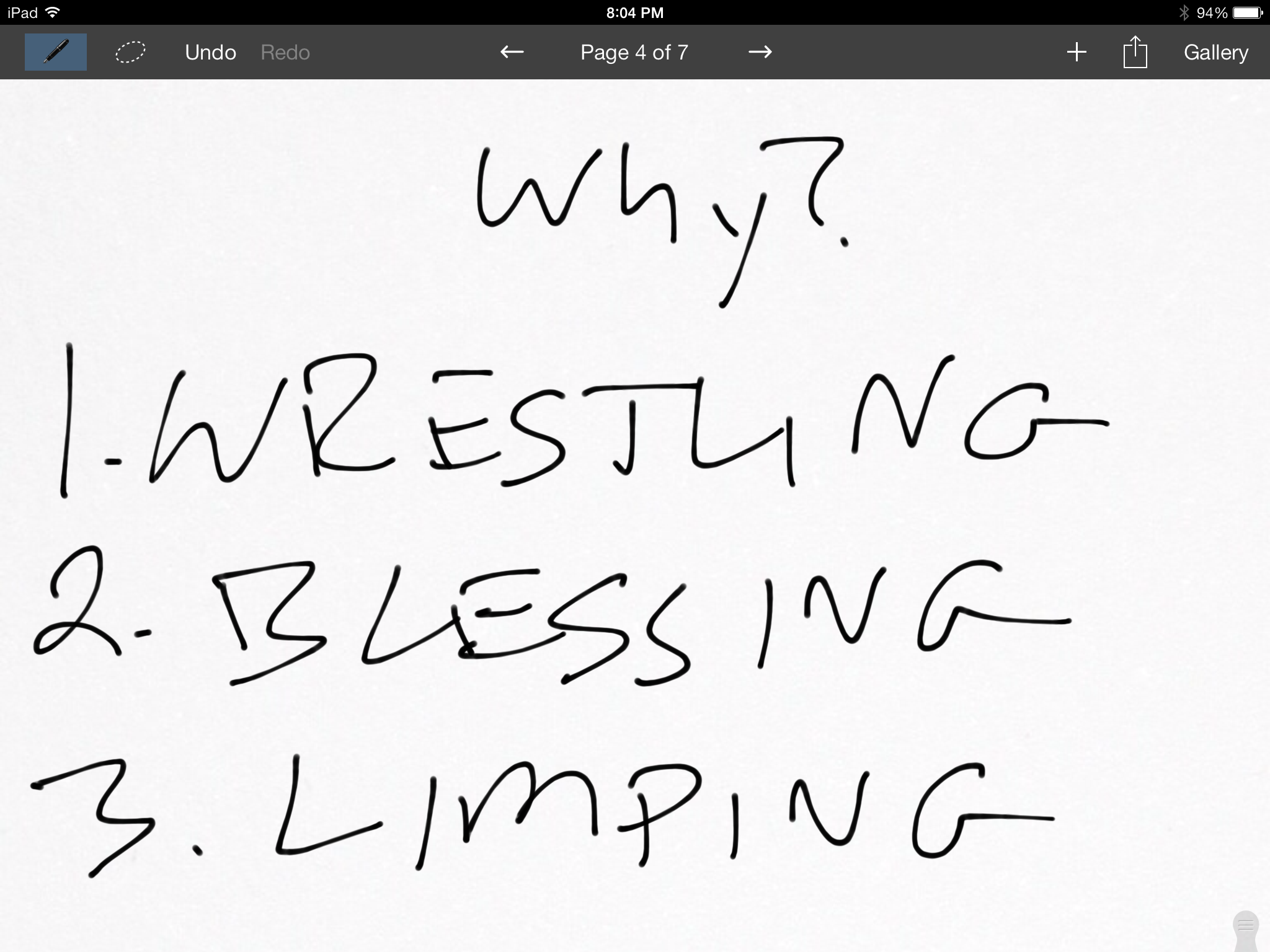
3 reasons, I think.  Number one is that Jacob wrestled with God.  Number two is that Jacob was blessed after the wrestling.  And number three is that he was left limping for the rest of this life.
Okay. Let’s start off exploring these three things by drawing a line.  We can call this line “Construction.”  This is the stage of life where we, as humans, construct our faith.  This is where we build it up.  This we give Bibles to our childrimageen and tell them that God loves them deeply.  We tell them stories about God making the world and Daniel and the Lion’s Den and David and Goliath, and how but we leave out the part where David cuts Goliaths head off and brings it back to his army base.  And then as they grow older, we talk about Jesus, and sin, and redemption, and doctrine, and grace, and love.  Construction.   Building up of faith in our lives.  Love it.

And then, we draw a second line.  We can call this line deconstruction.  This is where we wake up one day and realize that not everything fits into nice little boxes.  Deconstruction is where we start asking questions.  We ask questions about the Bible, such as why are there two creation stories?  And if Genesis was written thousands of years after Jacob lived, who wrote down this story? Or we ask questions about how God seems so violent, why people use their faith to justify violence, or about the role of church of and state.  We look around at other religions and they seem like nice people too, or we wonder how evolution and the Bible work together.  This is called deconstruction.  I like to say that deconstruction is where we wrestle with God.

This is deconstruction line is the realm of university students.  They move away and start asking questions, and we wonder if they’re ever going to find their way back to church.

Deconstruction can also be a lonely place, especially if one’s faith community is primarily in the construction phase, and you aren’t allowed to ask questions or doubt or disagree. You can also stay in deconstruction a long time… measuring this in years is not out of the question, maybe even decades.

But then, staying here in deconstruction isn’t the best either.  This is where angry people hang out.  This is where the Debbie Downers and Negative Nellies live (with all apologies to the Debbies and Nellies who are reading this).  Living in permanent deconstruction can quite easily lead into cynicism, arrogance, and relativity.

So let’s draw a new line.

We’ve had construction.  Then we’ve had deconstruction.  And then we have reconstruction.

This is where we rebuild our faith, only this time it’s deeper.  It’s filled with mystery.  It’s filled with more love, especially for those not like us.  It’s filled with more grace.  It allows paradox.  It holds less things tightly. It’s more empathetic.  It’s better at loving our enemies.  It’s less anxious.  It’s filled with more peace.  It’s more giving.  We have reconstructed our faith in the image of Christ.  This is the stage where we can really say with all sorts of authority, no matter what our lives look like – God has blessed us.

We have wrestled with God, and God has blessed us.

Back to the three things about this story.  I believe that these are the first two reasons why we have this Jacob story passed down to us for thousands of years.  It’s okay to wrestle with God, and at the end, if we make it to sunrise, we will see God’s blessings all around us.

But before we go to the limp, a few things about these three lines.

I haimageve drawn them linearly. In reality, it looks like this:  A three dimensional scribble of life that goes in all sorts of unexpected places.
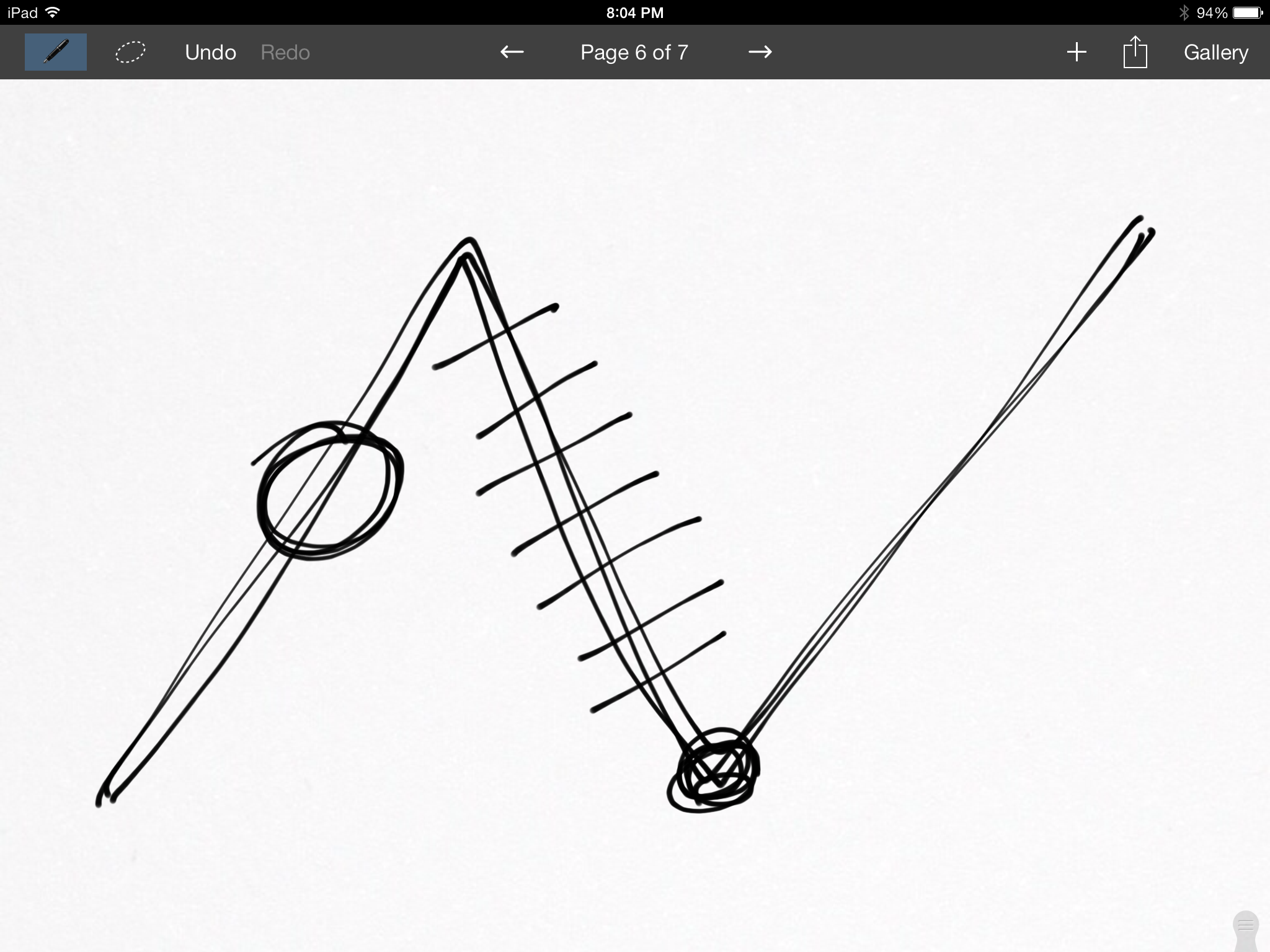
Life isn’t linear.  We love and we lose and we win and we hurt and we suffer and then we believe this and then we believe that and then we don’t know what to believe anymore, let alone how to act.  This movement is not always linear, but I just found it easier to draw.

Secondly, I turned 32 this week.  If I reflect, I can look back at my own story and find these themes.  I can look to Sunday School and youth and working at camp as all part of my construction.  And then I can look at my time in university and living in Zimbabwe and then working in churches and seeing their dark side as deconstruction.  And then I can look at my spiritual direction and prayer life and book reading and learning from Mel as learning to love better as all part of my reconstruction.

And the great irony of this is that most likely, on a big life timeline, I am probably somewhere over here, still in the “construction” phase.  If any of us at 32 think that we’ve arrived, we are probably wrong.  This is a life long journey.

Okay…  There’s more, but let’s talk about the limp first.

Why the limp?  Why would the stranger touch the hip of Jacob and leave him limping for life?

We only grow and mature because we have to.  Life forces us to.  And, to quote Richard Rohr, the only things that make us grow are great love and great suffering, and great love always leads to great suffering.  And suffering will leave us with a limp.

image1Let’s go back to the timeline.  You’re here, life is great, and you’re singing kumbaya every Sunday.  And then, you experience some sort of suffering that doesn’t fit very well into this (look at the lines on deconstruction part).  It could be a job loss.  It could be that someone close to you passes away.  It could be a health crises.  It could be the end of a relationship or a marriage.  It could be that you prayed for something and it didn’t happen.  It could be an intellectual crises, like you read a book and now you don’t know what you believe anymore.

These are some of the things that life throws at us, these things that we don’t have control over, and they force us to grow and mature.

Life throws us curve balls, and they leave their marks. They leave us limping.

This is the story of Jacob.  He was raised up.  And then, either through his own actions or the actions of others, he lost control of his life.  He had to run away to avoid his angry brother, his father in law manipulated him, his wives were trading mandrakes for sex, so I’m assuming that home wasn’t a bastion of peace.  All these stories moved him along, and they represent the wrestling.  And at the end, he made it to sunrise, he saw the blessing, but he was limping.

We grow, we wrestle, we see our blessings, and we are limping.

Richard Rohr says, “Wrestling with God, with life, and with ourselves is necessary. . . The blessing usually comes in a wounding of some sort and for most of us it is an entire life of limping along to finally see the true and real blessing in our life.” 

This is the story of Jacob wrestling a stranger in the night.  It’s a story about wrestling, a story about blessing, and a story about limping.

It’s an ancient story, but it’s also an invitation. An invitation for us to wrestle with God.  And invitation for us to look for your blessings.  And an invitation to embrace the limps and scars that we acquire along the way as part of our growth.

It’s an ancient story, but it’s really an invitation. An invitation for us to wrestle with God.  And invitation for us to look for your blessings.  And an invitation to embrace the limps and scars that we acquire along the way as part of our growth.

Handsome Kyle, Chambers of Death, and Stubborn Men

Based on Proverbs 8

______________________________________

Have you ever searched the original language and meaning of what your name means?

For example, the name Kyle is Gaelic in origin, and it means “fair and handsome.” My parents must have known what known what they were doing when they named me 31 years ago.

Ashley’s name means, “One who lives near the ash forest”, so obviously I win that one.

Do any of you know the meaning of the name “Sophia”?

You probably don’t, because why would you, so I’ll help you out here.

Sophia is the Greek word for wisdom.  Wisdom in Hebrew is the word Hochma, but we’ll stick with the Greek this morning.

Sophia means wisdom.

And did you notice something about the text this morning? It kept referring to Wisdom as a she.  A person.  A woman.  The ancient Israelites personified wisdom as a woman.  This is where we get the name Sophia from.

Wisdom is a woman.  This is going to go fun places, so stay with me here.

In verse 2-3, we read that Lady Wisdom calls out in the public square.

At the highest point along the way, where the paths meet, she takes her stand;  beside the gate leading into the city, at the entrance, she cries aloud:

“To you, O people, I call out; I raise my voice to all humankind. You who are simple, gain prudence;  You who are foolish, set your heart on it.  Listen, for I have trustworthy things to say; I open my lips to speak what is right.”

Lady wisdom, Sophia, is in the middle of the city, in the public, calling people to listen to her.

Why is this important?

Because the previous chapters give a warning against the adulterous woman, which is also “folly”, or “foolishness” personified.  The adulterous woman is in the middle of the city, in the public, calling people to listen to her.

And the writer of Proverbs has this to say the people who listen to her:

With persuasive words she led him astray:  she seduced him with her smooth talk.  All at once he followed her like an ox going to the slaughter, like a deer stepping into a noose, til an arrow pierces his liver, like a bird darting into a snare, little knowing it would cost him his life…

Do not let your heart turn to her ways or stray into her paths.  Many are the victims she has brought down:  her slain are a mighty throng. Her house is a highway to the grave, leading down to the chambers of death.
So don’t follow that woman!  Follow this woman instead!

_____
Quick aside.  Both foolishness and wisdom are personified as women here, because really, most of this ancient literature was written by men, for men, in a patriarchal sexist society.  We all know that men can be wise and men can be foolish, and men can cause people to lead astray as well.  Especially Derek Shepherd from Grey’s Anatomy (McDreamy!).

And also, I think that while the adulteress is framed as a sexual temptation, I think it’s a heck of a lot more than that.  I think it’s a metaphor for foolishness, for folly, for being unwise.  But what’s one way to get a young man’s attention?

And, finally, this text was written in a different era and culture than ours, so we’ll try working at this sexist text without being too sexist.

Okay, aside over.

______

So Lady Wisdom wasn’t just there to offer a different voice to the Lady Seducer over there.  Oh no.  According to the ancient Israelites, she was much, much, more than simply that.

Sophia, Lady Wisdom, was the first of God’s creation.  She was there when God made the heavens and the Earth.

When God said “Let us make humankind in our image… male and female he created them”, Lady Wisdom was one of those characters that was there.  She was constantly at God’s side, and delighting in all that God made.

But it doesn’t just stop there.  No no no no.  The ancient Israelites even kicked it up a notch.  They were audacious enough to borrow language from other cultures and set her up as a semi-deity, as permeating all creation, as nothing short of being God’s presence “up close”.  Ancient poems from the apocrypha write that Sophia creates the world, pervades all that is, and is the one in whom God and humans meet (Tom Yoder Neufeld in Studying Jesus – Learning Christ).

According to Old Testament wisdom literature, if you want to see what God looks like, all you need to do is look at Sophia, Lady Wisdom.  God, up close, looks like a woman named wisdom.

Whoa.

But it just keeps getting more mind blowing, and hopefully in ways that are a little bit applicable to our daily lives.

So, this Old Testament wisdom literature was written about 900 years BCE.  And then, about 900 years later, this guy named Jesus came and did stuff… said some stuff… and rose from the dead.  And the early church believed that this guy Jesus was kind of big deal, kind of important…

So as they were writing letters to each other, and writing songs, and writing down the stories of Jesus, they were looking for ways to connect this Jesus guy to their Jewish story.  They believed that Jesus was not only an important part of the Jewish story, but the climax of it, the culmination of it, the pinnacle of it, and so they were looking for language and metaphors and similes and poems to express that.

And as they did this, they remembered a woman named Sophia from the wisdom literature.

And they not only borrowed the language used to describe wisdom to describe Jesus, but they also named Jesus as THE wisdom of God.

In John chapter 1 – In the beginning was the Word, and the Word was with God, and the Word was God.  All things came to being through him.

This is even a bigger deal when smart biblical scholars tell us that the Greek words for wisdom and word were used interchangeably in the Old Testament.   So we can say “In the beginning was wisdom”.

And then the wisdom became flesh and lived among us, and we have seen his glory, the glory of a father’s only son, full of grace and truth.

Or we can read Colossians 1 as well.

The writer of Colossians 1 re-wrote a poem about wisdom to be a poem about Jesus.  He calls both wisdom and Jesus the place where “all the fullness of God was pleased to dwell.” (Tom Yoder Neufeld again).

The writer of Colossians 1 fused the notion of wisdom as co-creator of the world with the wisdom of the cross, the wisdom through with which the world is being reconciled.

Jesus is described as wisdom.

This is huge for two reasons:

1)  The New Testament writers used the language to describe a woman, Lady Wisdom, to describe Jesus.

I love this.  If we understand God to be beyond gender, some of us get hung up on Jesus being a male.  So, I think comparing Jesus to Lady Wisdom addresses some of that.  But also, it fits well with what Richard Rohr says.

“Like many other people I’ve continually wondered why Jesus came to us as a man and why he chose twelve men… I think that if Jesus had come as a woman, and had this woman been forgiving and compassionate, and had she taught non-violence, we wouldn’t have experienced that as a revelation.  ‘Oh well, typical woman,’ we would have said. 

But the fact that a man in a patriarchal society took on these qualities that we call ‘feminine’ was a breakthrough in revelation.  So he spent three years teaching twelve men how to do things differently – and they almost never caught on.  And for two thousand years the men in the church have never caught on. Because we wanted a God of domination.” (In Simplicity).

I just love that.  Jesus and Lady Wisdom are in cahoots because men are stubborn and have a tendency to see themselves as a hammer and everything as a nail, and power and fear and violence and domination are not part of the Kingdom of God.

2) Second reason why Jesus described as wisdom is a big deal.

So if you want to see what God looks like, look at Jesus.

If you want to see what God is like, look at Jesus.

Jesus is the center of what God is doing in the world.

This is actually one of the defining beliefs in Anabaptism.  Palmer Becker writes that there are three core values to Anabaptism. One, that Jesus is the center of our faith.  Two, that community is the center of our lives.  And three, that peace and reconciliation is the center of our work.    These three things permeate everything we believe and do.

And, when we place Jesus in in the center of our faith, we join the company of the New Testament writers who used Old Testament language of wisdom to describe Jesus.

By making the connection between Jesus and wisdom, we see that Jesus, like wisdom, is the lens through which we see faith.

The center of Christianity isn’t the Bible.  It’s Jesus.  We look through the Bible to see Jesus  (Thanks Pete Enns again).  The Bible is like a treasure map, and the treasure is Jesus.

I came across something great by Brian Zahnd about God being revealed to us through Jesus, and all the ways that helps us see the character of God.

“Once we understand that Jesus is image of God, the exact imprint of God’s nature, and the only perfect theology, we can answer some important questions about God that in the past we humans have often gotten wrong.

Does God send the storm?  No. He calms the storm.

Does God cause famines?  No.  He feed the hungry.

Does God inflict sickness?  No.  He heals the sick.

Does God shun sinners?  No.  He welcomes them.

Does God condemn the guilty?  No. He saves them.

Does God blame the afflicted?  No.  He shows them mercy.

Does God resent human pleasure?  No.  He turns water into wine.

Does God take our side in our hostilities? No.  He humanizes the other side.

Does God kill his enemies?  No.  He forgives them.

Does God return with revenge on his mind? No.  He comes with words of peace.”

I think that knowing that God is revealed in Jesus, is wisdom.  I think that feeding people and welcoming people and showing mercy and forgiving enemies and bringing peace, is wisdom.  I think that living self-sacrificial lives for the benefit of others, is wisdom.  I think that living our lives as a gift, and returning that which have been given, is wisdom.

Oh, Sophia, you lady wisdom you.  May we continue to find you, and find life.

Amen.

SCOTUS, Binders, and Cheap Mennonites

Based on Proverbs 1:1-8, 3:1-8

The book of Proverbs is for gaining wisdom and instruction, for doing what is right and fair, and for giving knowledge and discretion to the young, and the understanding of sayings and riddles.

Don’t forget these teachings, my children.  Keep them in your heart, and the Lord will surely bless you.

This is a book of life lessons.  I love life lessons.  Wisdom to keep us on the right track, the straight and narrow.

This is how we treat the book of Proverbs, right?

This is also we treat our Bibles.  We treat it like an answer book, a book of rules that God wants us to follow, like an instruction manual.  This is why people sometimes think that the word Bible is an acronym for Basic Instructions Before Leaving Earth (They’re wrong).

If people would only just follow the Bible, then we’d all be in good shape, right?

_________________________
Let’s talk about the Supreme Court’s decision to legalize same-sex marriage in all 50 states.  Because, you know, if you log into Facebook, you saw a lot of rainbows this last week.

Some of us were excited about the court’s ruling.  Others of us not were not excited about the court’s ruling.  And still others of us didn’t quite know what to think about.

My intention this morning isn’t to declare one side right and one side wrong, but rather, to make note of how some of us use our Bibles in forming an opinion.

Someone would say, “Leviticus says this!”

And someone else would say, “But it also says this!”

But what about this verse?

But what about that verse?

But what did Jesus say?

But what did Jesus NOT say?

But the Bible clearly says!

No it doesn’t!

And so forth and so forth.  We chuck Bible verses around to prove something, usually that what we believe is right, with the hope that we can deliver that knock-out punch to end the conversation and declare ourselves the winner.

A great example of this is what one of my pastor friends posted last weekend.

I have been amazed over the last couple of days how many times my Facebook feed has been filled with people talking about the ‘sins of Sodom and Gomorrah’. My guess is they are probably referencing Ezekiel 16:49 ‘Now this was the sin of your sister Sodom: she and her daughters were arrogant, overfed and unconcerned; they did not help the poor or the needy.’ – A big shout out to Richard Bage for this one.

I love it.  He can just drop the mic and walk away, because it’s my hunch that most people quoting the Bible about the sins of Sodom and Gomorrah haven’t read Ezekiel in a while.  Heck, I haven’t read Ezekiel in a while.   Ezekiel’s long and boring.

But what in the world are we supposed to do? Proverbs says that this is all about wisdom and making our straight path, and there are Christians who are convinced that the Supreme Court decision on same-sex marriage is a national tragedy, and there are others quote Martin Luther King Jr. saying that the arc of the moral universe is long, but it is bent towards justice.

_____________

Let’s talk about elections, because, you know, there’s one coming up.

A couple of years ago, Ashley’s aunt, who works in a high school in Winnipeg, took some of her students to an election debate.

It was a debate between local candidates, all vying to become the Member of Parliament for their riding.

She was hoping that her kids would see people debating different ideas and policies on how to make our country run better.

I talked to her a few days later, asking how it went, and she said,

“What a waste of time.  But especially one of them.  He had a binder, and when a question was asked, he would open their binder to the right section and read what was written there.  Question about climate change?  Hmmm… climate change… Our party believes this.  Question about taxes?  Hmm… taxes.  That’s under the T… Our party believes this.  My aunt said that sometimes it was painfully obvious that the guy didn’t even know what he was reading.”   By the end, all the students knew who they didn’t want to vote for.

When everything is cut and dry, black and white, it can often leave us a bit unfulfilled.  “When they ask A, you answer B.”  “When that happens, this is how you respond.”  Can all of life be reduced to simple equations?

_____________________

Let’s go back to Proverbs, our little book of wisdom that’s trying to help us live right.  Let’s take a look at what it says about money, because we loooove talking about money.  (Thanks Pete Enns for helping me out with this).

Proverbs is full of advice on how to treat money.

The wealth of the rich is their fortress;  the poverty of the poor is their ruin.   This seem simple enough.   Wealth can protect us, while poverty can make our lives a lot harder.

The wealth of the rich is their strong city; in their imagination it is a high wall.  So, is that fortress we just read about real or fake?

The wage of the righteous leads to life; the gain of the wicked to sin.  So, here is says that wealth neutral, but what matters is what kind of person you are.

And then finally, Those who trust in their riches will wither, but the righteous will flourish like green leaves.  So we’re supposed to depend on being righteous, not our riches.

So… our wealth is either a fortress, an imaginary high wall, or it will cause us to wither.

Which is it?  What’s the right answer?  What does the Bible say? (Wait a minute.  This is the Bible!)?  What does God want me to do?

I think those are the wrong questions.  Because, if we treat Proverbs, or our Bibles, like a little rule book, like an instruction manual, it doesn’t work all that well.  We can’t.  Does our wealth protect us, or cause us to wither, because those seem to be pretty opposite.

The answers aren’t all that clear, are they?

It’s not about using Bible verses as a little rule book.  Not only does it not work, but it’s not wisdom.

“Wisdom isn’t about finding a quick answer to life – like turning to the index, finding your problem, and turning to the right page so it all works out. Wisdom is about character formation. Wisdom is about learning how to work through the unpredictable, uncontrolled messiness of life so you can figure things out on your own in real time.  Wisdom doesn’t tell you what to do.  It shapes you over time so when the time comes to have to think on your feet, you can make a wise decision.  Wisdom makes you fit to think for yourself when you need it.”  (Thanks Pete Enns again, as found in The Bible Tells Me So.  P. 138).

The answers aren’t clear because the answers are always contextual.

Let’s use a simple example.

If someone were to ask you the question, “Should I drink wine with my child?”, how would you answer?

Well, if the kid is 4 years old, the answer is “No.”

If the kid is 17, the answer is, “Ummm… Depends.”

If your child is 40, you say, “Sure.”

If either of you are recovering alcoholics, you say, “No thanks.”

And, if both you and your child are good Mennonites, you ask, “Well, how much does the bottle of wine cost?”

This is wisdom.  It’s not a little answer book.  It’s about character formation, so that we can make the right decision when we need to.

This is what Proverbs is all about.   Not simple answers.  Character formation.  Wisdom is about character formation.

__________________

I’m going to make one more point about wisdom and treating the Bible like a simple little rule book.  It can get a little bit confusing, at times.   It can be hard to know what it says and what it doesn’t say.  Plus, there are much smarter people out there than us who spend their entire lives studying the Bible, and they STILL come to opposite conclusions.

Well, instead of asking “What does God want us to do?”, let’s ask, “How does God want to form us as  Christians?”  And when we ask that question, we find a really great piece of wisdom in Proverbs 3:

 Let love and faithfulness never leave you;
bind them around your neck,
write them on the tablet of your heart.
 Then you will win favor and a good name
in the sight of God and humankind.

 Trust in the Lord with all your heart
and lean not on your own understanding;
 in all your ways submit to him,
and he will make your paths straight

Let love and faithfulness never leave you, and you will be okay. Trust in the Lord that love and faithfulness are the way forward, and our paths will be straight.

Love and faithfulness.

And, if any of you are like me, you will know that there is no simple instruction manual for love and faithfulness.  It’s like parenting.  We’re all just winging it and hoping for the best.  There is no Staples Easy Button.  Love and faithfulness is a long, complex journey, full of highs and lows, steps forward and steps backward… But as long as we are doing our trying to be faithful to God and loving to everyone, I think that’s a good start.

Design a site like this with WordPress.com
Get started